Author: Trevor W. Goodchild (Page 6 of 7)

Airbnb’s Interesting Windfall During Covid


While you're jamming to great music working from home, ever get cabin fever? Airbnb is the go-to choice to escape the confines of your home/office/sometimes-prison.

Isn't it struggling like other businesses right now due to covid?

Yes & No.

Airbnb was founded in 2008 by  Brian Chesky and Joe Gebbia then later, Nathan Blecharczy. They had the zany idea of just putting an air mattress in their living room in San Francisco and marketing that as a Bed and Breakfast. Yet now, Airbnb is a household name.

The founders are all billionaires at this point. The company was planning on going public this year, until the Corona Virus pandemic bottomed out many markets world wide.

Now, Airbnb bookings have tanked like Jurassic Park sequels.

According to AirDNA bookings in Europe collapsed in March, dropping 80% compared to the prior week in the week starting March 9, and another 10% on top of that for the week of March 16.

Today Sydney’s Opera House, Bangkok’s night markets, the Louvre Museum in Paris and the Colosseum in Rome are empty of those annoying tourists whose money generated significant income for cities, above & beyond just the gig economy.

Airbnb honored cancellations by all the guests despite how much this pissed off hosts. Founder Brian Chesky explained, in a letter to Airbnb Hosts,

"If we allowed guests to cancel and receive a refund, we knew it could have significant consequences on your livelihood. But, we couldn’t have guests and hosts feel pressured to put themselves into unsafe situations and create an additional public health hazard."

"We determined that we had to allow your guests to cancel and receive a full refund—including all our fees. Please know this decision was not a business decision, but based on protecting public health."

"However, while I believe we did the right thing in prioritizing health and safety, I’m sorry that we communicated this decision to guests without consulting you—like partners should. We have heard from you and we know we could have been better partners."

Airbnb intends to give a $250 million payout for the Airbnb hosts who lost income as guests canceled their stays due to the C-19 pandemic.

The founders are also creating a $10 million Superhost Relief Fund designed for Superhosts who rent out their own home and need help paying their rent or mortgage.

Not everyone views the economy crashing as a bad thing, for this particular industry. Critics bring up valid points on how Airbnb causes housing shortages as Short Term Rentals (STRs) are empty saved for Airbnbers while local residents can't find a place to call home.

Some of the most stinging critique comes from Lionel Laurent of the Bloomberg Opinion column:

"Paris has 100,000 empty homes and 100,000 second homes, according to the mayor’s office, fueling a sense of social injustice. One study of Airbnb in a Lisbon neighborhood between 2015 and 2017 found it looked less like a sharing economy and more like a buy-to-let craze, with 99% of short-term rentals marketed all year round."

I went to Paris for the first time last year and stayed in a charming chateaux, complete with a hookah and Pink Floyd on vinyl. But, like most tourists, I didn't consider locals may be put out by not having a place to rent.

Definitely food for thought. Laurent continues his comments here:

“Short-term rentals have had a disastrous impact on cities’ rental markets,” McGill University’s David Wachsmuth told The Intelligencer...Will a post-Covid-19 society really want that back?"

This is a good question, Laurent makes great points. Honestly, I think given the C-19 occupation limits and social distancing, Airbnb is a marriage of convenience that wins out over social justice concerns however justified.

It's more than just ease of use, staying at a vacation rental is now about safety and Airbnb offers a contactless check in & out system unlike most hotels.

While many things seem bleak, and doom scrolling frames things in a negative light ("It's sunny outside honey" "Yes but it must be part of a plot!") - there is an upside. We aren't losing Airbnb yet.

Airbnb's Windfall

For Airbnb hosts who have places in rural settings the market is booming thanks to cabin fever. Many want an escape and this is the perfect way to do so.

Rural hosts earned over $200 million dollars in just June 2020 alone, in the USA, according to Airbnb's newspage.

According to CNBC:

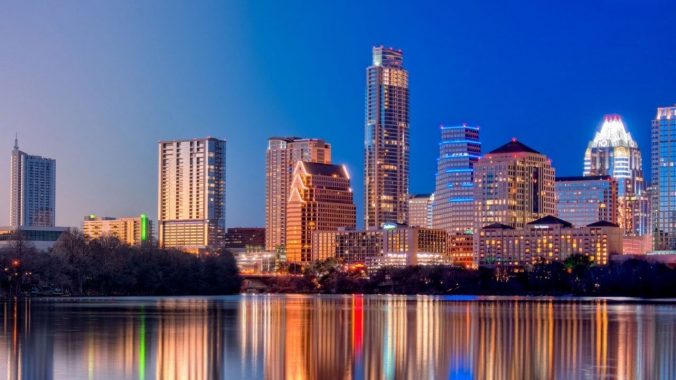
Trisha Mixer lost over $40,000 worth of bookings for her two properties outside Austin, Texas, when Covid-19 hit. But once the state started reopening in May, she said, she was “barraged” with requests. “You could tell people were desperate,” Mixer said.

Mixer’s two properties, a lake house and a cottage, are 30 and 90 minutes away from Austin, respectively, and the majority of her recent customers are other Texans — even people from Austin who just want to get away.

Summer weekends have always been popular, but this year she hasn’t had to do extra to fill up weekdays too. Mixer even raised prices a little to try to slow down the pace of bookings, but it didn’t work.

Her properties are filled through the summer, and weekend business looks steady through the end of October. On these getaways, just some space and, if possible, a swimming pool might be enough.

At Kathryn Langer’s property in Lake Travis, Texas, which sleeps nine people and does have the coveted pool, it is the “busiest and craziest” time in her four years of hosting on Airbnb. People are “stir crazy,” she said, adding that she had a guest who booked in May and then rebooked for August without having visited the first time yet.

Part of this is because of how scared people are of traveling now due to the added risks of catching the Corona Virus. It's much easier to find an Airbnb out in the country a few miles away from your city than it is to book a flight, wade through a crowd of strangers to and from your vacay destination.

In fact, I think I am going to have to check out some of the nearby lake view Airbnbs. This sounds like a safe easy get-away compared to braving an airport right now.

What about you? Willing to brave flying to an exotic destination, or stay in your state and hit up a rural Airbnb?

             .  .  .

Enjoyed this blog?
Signup here to get updates on new startup blogs.
Is Facebook not explaining why the disapproved an ad?
I worked at FB for years and offer FB Policy Consulting here

Available for freelance writing and guest posting on your blog: [email protected]

Trevor W. Goodchild

Best Music To Work To


Last blog we discussed Time Management Tips, now let's talk about work music. Do you listen to music while you work?

It's pretty interesting that there are studies that show listening to music while you work can help boost productivity.

In the Psychology of Music journal, it was found that music increased the quality of work in software developers:

"Effects of music on work performance, in this case, software design, may be explained by increases in state positive affect. Data from 56 (male = 41, female = 15) developers were obtained from four different Canadian software companies.

Data were collected in the participants’ actual work environments over five weeks. Results indicated that state positive affect and quality-of-work were lowest with no music, while time-on-task was longest when music was removed."

Apparently, when you're in a good mood this improves the kind of work you do:

"Narrative responses revealed the value of music listening for positive mood change and enhanced perception on design while working. Evidence is provided of the presence of a learning curve in the use of music for positive mood alteration."

So what type of music is good to listen to?

Classical music apparently has some pretty incredible associations with developing cognitive development. In the Nature journal, Christopher Chabris found that:

"Rauscher et al. reported that listening to ten minutes of Mozart's music increased the abstract reasoning ability of college students, as measured by IQ scores, by 8 or 9 points compared with listening to relaxation instructions or silence, respectively1. This startling finding became known as the ‘Mozart effect’, and has since been explored by several research groups."

I was in a car accident that almost took away my ability to walk, when I was 15 years old. Part of my healing process was listening to Bach Sonatas every day.

The hospital had confined me to a wheelchair, but I would crawl across the floor of the hospital room 100 times each night listening to Bach. No one told me to do this, it was instinctive.

Was that a significant factor in my head healing from a closed in head injury, when I was hit by a truck crossing the street? Possibly.

Hubspot suggests that listening to video game soundtracks is a good start for creating a playlist of background sounds to work to.

According to Business Insider, listening to songs you don't care about when working helps you focus because you can tune it out and not be distracted when your favorite jam comes on.
Some research indicates sounds of nature helps you focus while working but personally - I can't stand being distracted by the sound of animals making noises unless it's just the cicadas in the trees who have a very white noise effect.

I like listening to ambient sounds like Brian Eno's Music for Airports. When I was stuck at an airport for 2 days last year, because they over booked flights back home to Austin, I listened to Eno's Music for Airports while stuck...at an airport in Miami, Florida.

I'll never forget staring out of the window at the tarmac where the planes were taxi-ing up for docking and listening to that album - one of my favorites.

It works while you work to help you work because it's ambient without loud vocals to distract you from doing what you need to do.
Here's a cool playlist of ambient background sounds called:

Focused Work

When I worked at Facebook in the ads department, the sound of other employees chattering about personal drama was super distracting for the work I was doing and I desperately needed a solution.

Then I remembered back in college, my photography professor introduced me to a neat station called Radio Paradise.

I was in heaven! Commercial free music, 24/7 365! It is still a favorite and I listen to Radio Paradise while working on projects for clients, or e-commerce. I've discovered so much new music through listening to it my music library has really expanded.

I definitely suggest you try it out if you're at a loss for music to listen to while working. This year I donated to them during their annual fundraiser to stay on the air and I'm glad Radio Paradise is still around during lockdown times as good music right now really helps!

For more variety you can also listen to instrumental electronica music, like a recent track by artist Xander Cage called, More Than A Simple Bet.

What music do you like to listen to while you work?

             .  .  .

Enjoyed this blog?
Signup here to get updates on new startup blogs.
Is Facebook not explaining why the disapproved an ad?
I worked at FB for years and offer FB Policy Consulting here

Available for freelance writing and guest posting on your blog: [email protected]

Trevor W. Goodchild

Time Management Tips for Entrepreneurs


Time management is a skill set not many are naturally talented at but it yields greater results than crossing your fingers and hoping you get everything done on your to-do list.

Entrepreneurs in particular are subject to having 500 projects, all half-finished, running at the same time because delegating time, energy and prioritizing tasks can be a challenge.

(More challenges: Congress Challenges Big Tech here)

The ability to self-direct is another talent that doesn't come naturally to everyone, let alone those brave enough to quit the 9-5 to start and run their own company.

You need two skillsets to be effective: time management & task management

According Journal of Universal Knowledge Management:

"Task management is the process of managing a task through its life cycle. It involves planning, testing, tracking, and reporting. Task management can help either individual achieve goals, or groups of individuals collaborate and share knowledge for the accomplishment of collective goals

Tasks are also differentiated by complexity, from low to high. Effective task management requires managing all aspects of a task, including its status, priority, time, human and financial resources assignments, recurrence, dependency, notifications and so on."  

I thought I'd share some effective time management tips with you on today's blog, from trusted sources, because, well, uh...we are all managing our own time now working remotely due to C19.

From Entrepreneur.com:

Break Down Your Activities Into Simple Problems

"Utilizing your consciousness requires more energy and can be avoided by simplifying your problems. Excellence in time management revolves around establishing a process and breaking it down into small, atomic operations that are easy to grasp and don’t require intensive resource consumption."

The idea is that you develop your own process that is generally the same for handling new activities or problems, but you adapt it to the situation.

This holds an advantage to producing repeatable results once you get in your groove for developing your new how for how you approach a task or problem.

When you break this process down into smaller steps, it's easier to systemize organizing your day instead of hitting that wall of overwhelm we feel when tackling everything at once.

From James Clear, author of Atomic Habits:

The Ivy Lee Method: The Daily Routine Experts Recommend for Peak Productivity

"By 1918, Charles M. Schwab was one of the richest men in the world. Schwab was the president of the Bethlehem Steel Corporation, the largest shipbuilder and the second-largest steel producer in America at the time. The famous inventor Thomas Edison once referred to Schwab as the “master hustler.”

He was constantly seeking an edge over the competition. One day in 1918, in his quest to increase the efficiency of his team and discover better ways to get things done, Schwab arranged a meeting with a highly-respected productivity consultant named Ivy Lee.

As the story goes, Schwab brought Lee into his office and said, “Show me a way to get more things done.” “Give me 15 minutes with each of your executives,” Lee replied. “How much will it cost me,” Schwab asked. “Nothing,” Lee said. “Unless it works. After three months, you can send me a check for whatever you feel it's worth to you.”

The Ivy Lee Method During his 15 minutes with each executive, Ivy Lee explained his simple daily routine for achieving peak productivity:

At the end of each work day, write down the six most important things you need to accomplish tomorrow.

Do not write down more than 6 tasks. Prioritize those 6 items in order of their true importance.

When you arrive tomorrow, concentrate only on the 1st task. Work until the first task is finished before moving on to the second task. Approach the rest of your list in the same fashion. At the end of the day, move any unfinished items to a new list of six tasks for the following day.

Repeat this process every working day. The strategy sounded simple, but Schwab and his executive team at Bethlehem Steel gave it a try. After three months, Schwab was so delighted with the progress his company had made that he called Lee into his office and wrote him a check for $25,000. A $25,000 check written in 1918 is the equivalent of a $400,000 check in 2015."

So why does this work? It's simple without too much over thinking or analysis needed.It forces you to make hard decisions eliminating the fluff and it removes the initial barriers to starting up.

Also instead of multitasking it forces you to focus on achieving one task which can improve the quality of your results.

From Pat Flynn:

Take Advantage of Just-in-Time Learning

""Just-in-time-learning" changed everything for me. That is, I only consume content related directly to the next task I have in the current project I'm working on.

Blog posts, podcast episodes, videos—they must help me with completing that next task on my priority list, or else it doesn't deserve my attention...at this moment.

'Just-in-time-learning' changed everything for me. FOMO (fear of missing out) does make this hard though, because there's so much great stuff out there we don't want to miss.

However, if you're smart about it and as you come across interesting and potentially helpful content you put it aside into a tool such as Evernote for easy access later, it can truly change how much you get done versus how much you learn.

I love this tip from Pat Flynn - so much of the time entrepreneurs become program-addicts, enrolling in course after course and not taking action with A+ syndrome - thinking it has to be perfect to begin.

Focusing on just consuming content related to achieving the next task is a way to laser focus actions for all of us info-aholics.

Pareto principle - 80/20 Rule

Can't leave out the most well known time management strategy can I? From Forbes:

"This “universal truth” about the imbalance of inputs and outputs is what became known as the Pareto principle, or the 80/20 rule. While it doesn’t always come to be an exact 80/20 ratio, this imbalance is often seen in various business cases:

• 20% of the sales reps generate 80% of total sales.

• 20% of customers account for 80% of total profits.

• 20% of the most reported software bugs cause 80% of software crashes.

• 20% of patients account for 80% of healthcare spending (and 5% of patients account for a full 50% of all expenditures!)

Instead of trying to do the impossible, a Pareto approach is to truly understand which projects are most important. What are the most important goals of your organization, or boss, and which specific tasks do you need to focus on to align with those goals. Delegate or drop the rest."

Investopedia has a good example here of how to apply the 80/20 rule as well.

Next up from Than Pham
:

Do the hardest thing first, every single morning.

"Do the hardest thing first, every single morning. When you start your workday, tackle the task you find the most difficult to do or are most likely to procrastinate on. When we postpone those kind of tasks till later in the day, we often get stressed about them and keep postponing them."

Thanh Pham quote graphic

"By flipping it, you can go on with the rest of the day knowing you were productive. Even if you did nothing else, you still had a productive day. I've done this for the last 5 years of running my business and it helped us tremendously. Everyone in our company does it too and it's part of our onboarding training to teach people this concept."

I haven't tried that one out, but I like the idea...and I probably would have benefited from applying it to my self-employment taxes this year as I literally waited until July 15th to file. 
?

From my own experiences running multiple companies from the comfort of my own home, I've found one technique really useful. So here's a tip from the Jetski Shaman blog:

Time Stamped Index Cards and/or Smart Phone Notepad

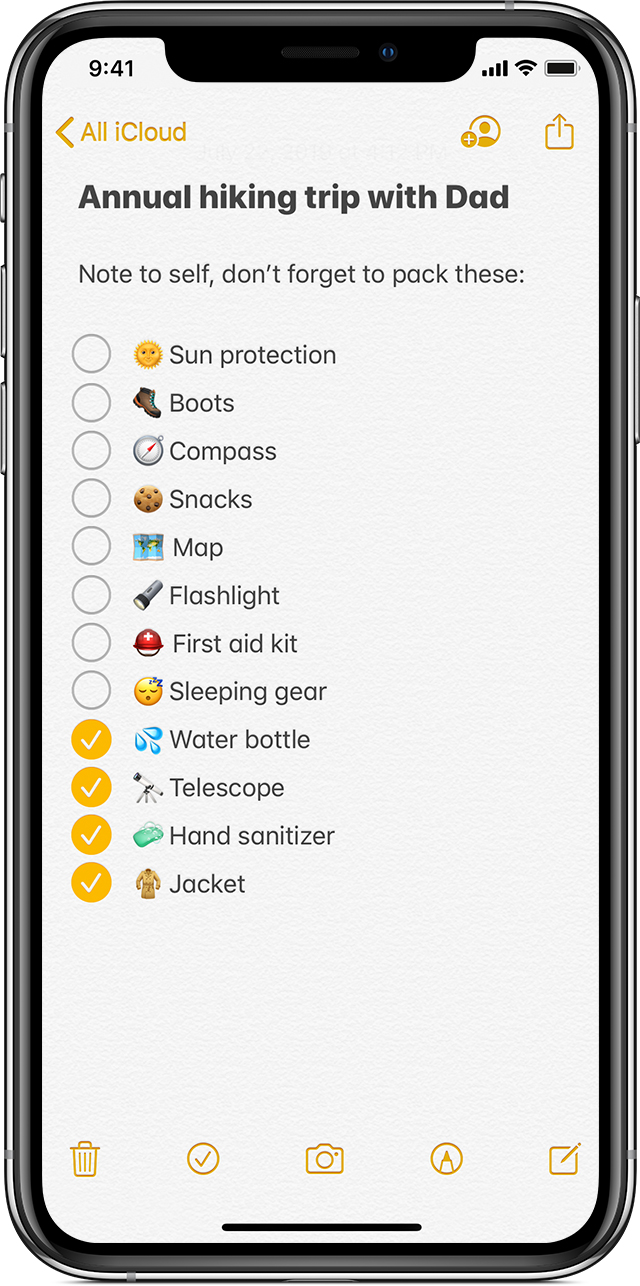
Writing down a list of tasks for the day on a index card inside a spiral index card book or on a notepad on my iPhone with the empty checkmark circle is always super helpful and motivating.

• Write down all the tasks you have to do for the day on an index card or digital notepad

• Read over them and determine what has the 1st priority, 2nd priority, 3rd priority & so on

• Re-arrange the order of the tasks on a new notepad or index card according to priority

• Add a time stamp before the 1st word of the task for what time you want to achieve it

• Check off the tasks as you complete them. Ahhh the feeling of completing a task!

Pro tip: add a 30 to 45 minute buffer between tasks to stay on track as it sometimes takes longer

Credit: Apple.com


What about you? What have you found to be helpful for time management?

For more time management tips check out this article on 34 Time Management Tips

               .  .  .

Enjoyed this blog?
Signup here to get updates on new startup blogs.
Is Facebook not explaining why the disapproved an ad?
I worked at FB for years and offer FB Policy Consulting here

Available for freelance writing and guest posting on your blog: [email protected]

business blog, business blog, business blog

Congress Challenges Big Tech Monopolies

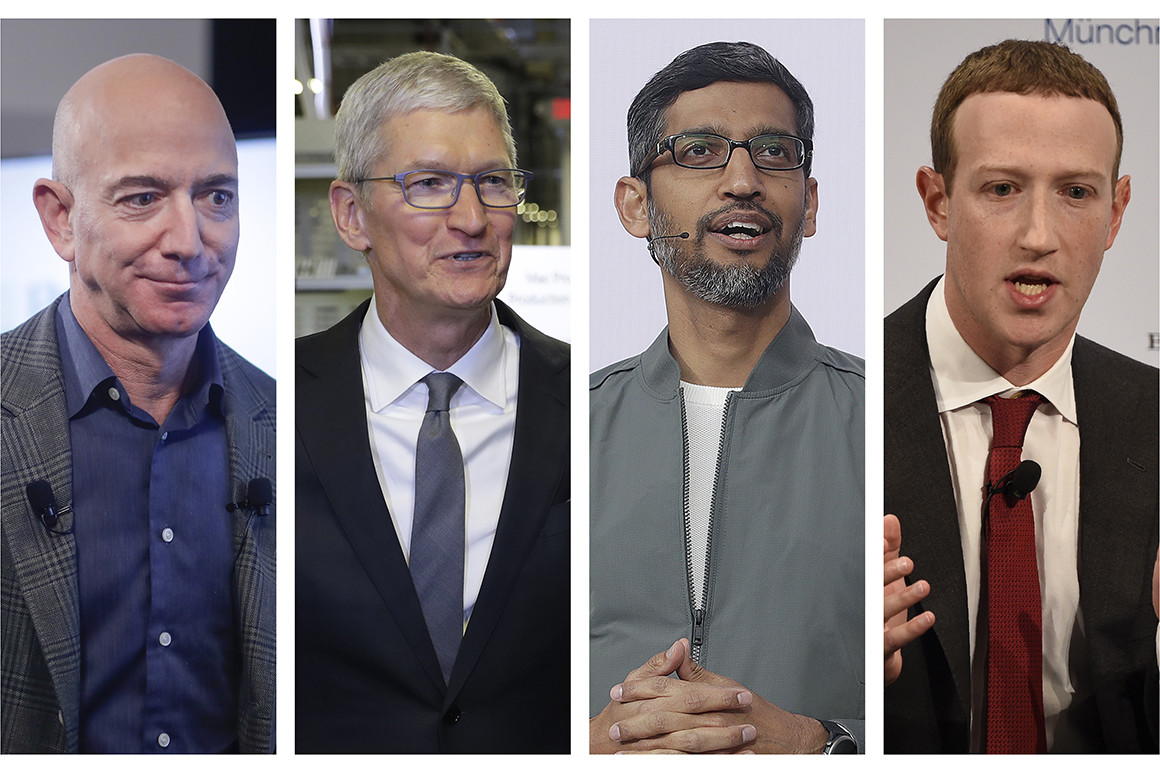
Credit: AP Photo/Pablo Martinez Monsivais, Evan Vucci, Jeff Chiu, Jens Meyer


Wednesday, July 29th, the 4 companies that make up Big Tech, Amazon, Apple, Google and Facebook faced off with Congress on allegations that their business's monopolistic practices stifle competition unfairly, breaking antitrust laws.

Facebook’s Mark Zuckerberg, Amazon’s Jeff Bezos, Google’s Sundar Pichai, and Apple’s Tim Cook testified (remotely) on the anti-competitive behavior of their companies.

The House Judiciary Committee began this investigation over a year ago and collected over 1.3 million documents about these business practices.

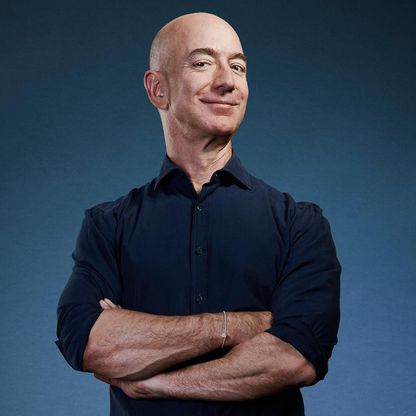
This marks the 1st time that Amazon CEO Jeff Bezos, whose net worth is 181 BILLION dollars, has ever faced Congress.

PHOTO BY MICHAEL PRINCE/FORBES COLLECTION


Big Tech CEOs appeared virtually before Congress for 5 hours facing relentless criticism of their business practices. Amazon's CEO Jeff Bezos' opening statement was:

“Just like the world needs small companies, it also needs large ones,”

The Committee Chairman Rep. David Cicilline likened the CEOs to kings and said Congress wasn’t going to bow down to them.

Graeme Jennings | Credit: AP


‘Your ability to dictate terms, call the shots, upend entire sectors, inspire FEAR resemble the powers of a private government. Our founders would not bow before a king, nor should we bow before the emperors of the online economy.”

Then the lawmakers cited details on the executives emails and internal documents they’d acquired, and pressuring Big Tech CEOs to explain how they got their market dollars.

Amazon’s antitrust investigation was considered less in depth as questions asked of Google and Facebook but there were some pointed questions asked.

These included how Amazon treats and handles 3rd party sellers on its website to whether or not the company properly regulates knock offs and counterfeit products.

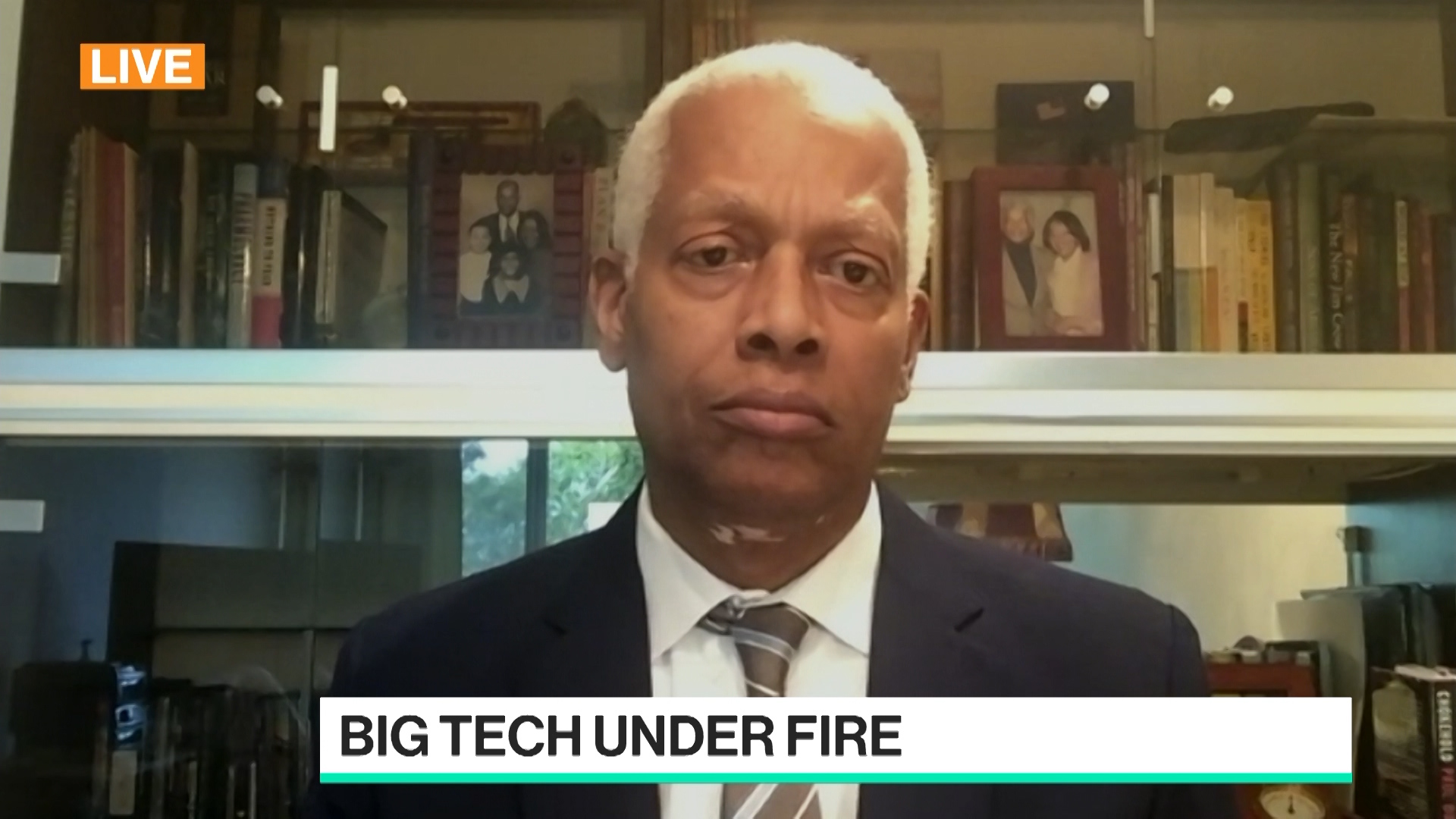
Credit: Bloomberg


Rep. Hank Johnson asked:

“Why isn’t Amazon responsible for keeping all counterfeit products off of its platform?”

Jeff Bezos replied:

“We do a lot to prevent counterfeiting. We have uh, a team of more than a thousand people that does this.”

Lawmakers cited a Wall Street Journal report from April this year that stated Amazon.com Inc. employees have used data about independent sellers on Amazon to develop competing products, at odds with their own stated policies.

Rep. Pramila Jayapal asked:

“Does Amazon ever access and use 3rd party seller data when making business decisions? And a yes or no will suffice sir.”

Amazon CEO Bezos replied:

“I can’t answer that question ‘yes’ or ‘no’ what I can tell you is we have a policy against using seller-specific data to aid our private label business but I can’t guarantee you that that policy hasn’t been violated.”

Which essentially means, yes, Amazon has data mined independent sellers’ data to compete against them but, will assign blame later to a scape goat. Maybe a few contract employees will get fired.

When your company gets big, it's good to remember why we do this, so humanity doesn't get lost just crunching numbers.

What do consumers in America actually feel about Big Tech’s dominance of the market?

72% of U.S. adults believe big tech companies have too much “power and influence” in politics, per a Pew Research survey conducted in June, while an Accountable Tech/GQR Research poll in July found 85% of respondents believe they have too much power in general. [Source: Forbes]

Google was playing for higher stakes because of how advanced the anti trust investigation is against them. The other 3 companies aren’t facing as serious of a monopoly charge as Google is facing.

It’s highly likely there will be a new law suit filed against Google in the coming months.

Congress asked questions relevant to their ongoing investigation against Google. One of which was how often does Google tailor search results to keep people on Google instead objective data, and info other websites provide?

Committee chairman Rep. David Cicilline asked:

“Did Google ever use its surveillance over web traffic to identify competitive threats?”

Google CEO Sundar Pichai responded:

“Congressman, just like other businesses, we try to understand trends from uh you know data we can see.We use it to improve products for our users,”

Almost the entire rest of Google’s time at the hearing was defending itself against charges that its search results don’t favor republicans.

Apple’s CEO Tim Cook didn’t get as many questions.

Most of the questions Apple got related to the App Store, and whether when a consumer is searching for apps if the search results favor apps Apple engineers over competitor apps.

Rep. Hank Johnson asked:

“Does Apple not treat all app developers equally?”

Cook replied,

“Sir we treat every developer the same. We have open uhhhh and transparent rules. It’s a rigorous process. Because we care so deeply about privacy, security and quality, we do look at every app before it goes on…”

Cook said that Apple acts fairly, pointing to the diversity of apps on the app store, as well as the benefits to consumers in having a wide selection instead of just Apple-made apps.

Facebook’s CEO Zuckerberg got many questions on misinformation and perceived political bias on the many social media companies they own.

Zuck replied:

“We do not want to become the arbiters of truth. I think that would be a bad position for us to be in.”

Speaking to the charges of monopolizing social media sectors, there were questions about social media companies Facebook has bought such as Instagram.

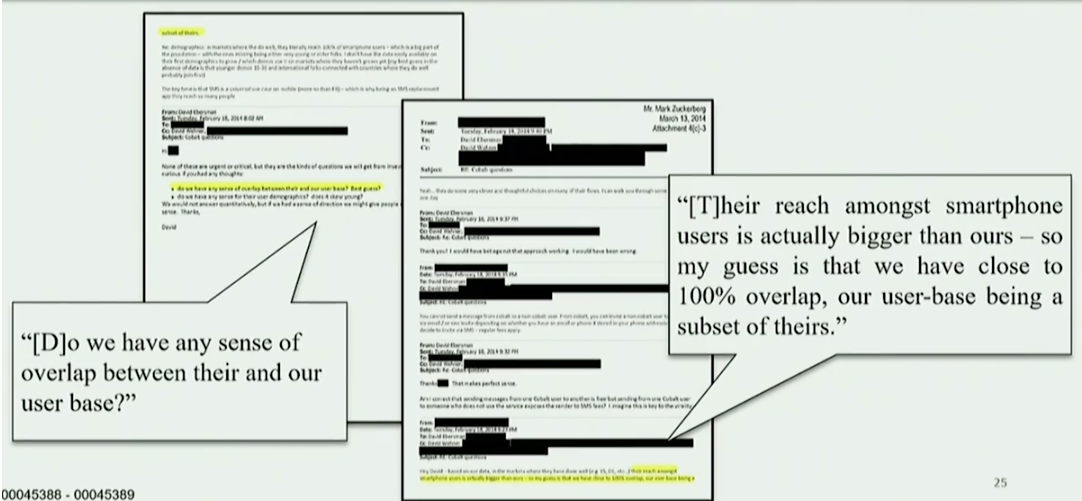
Ant-trust investigations into this exposed internal Facebook emails Mark Zuckerberg sent around the time of these acquisitions.


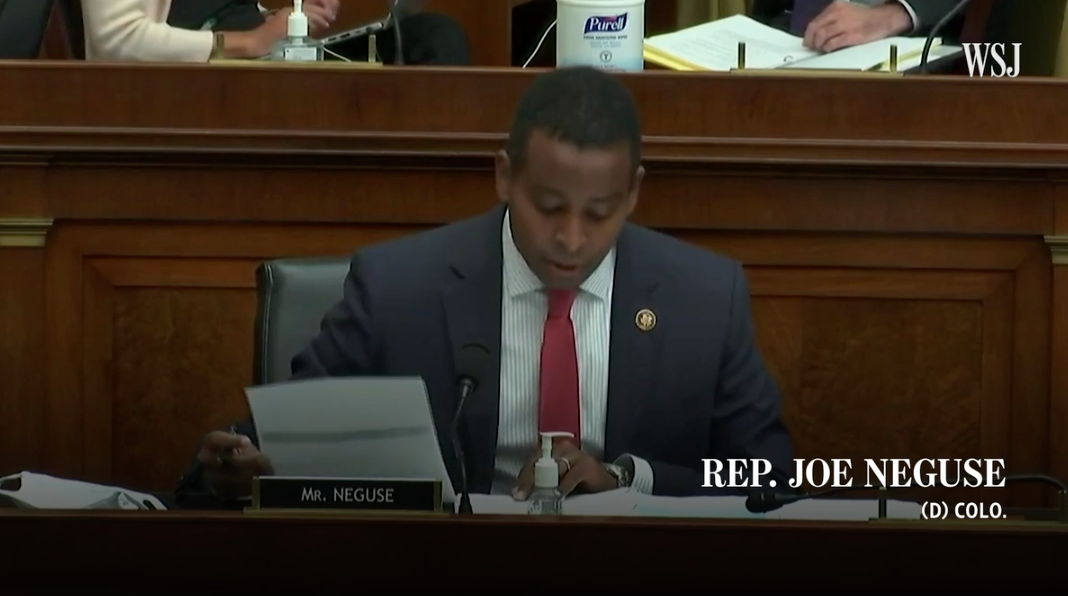
Rep. Joe Neguse said:

“Facebook also tried to buy other competitive startups…in fact you did tell one of Facebook’s senior engineers in 2012 that you can quote:

‘Likely just buy any competitive startup but it will be a while before we can buy Google.’

Do you recall writing that email?”


Facebook CEO Zuckerberg replied:

“Uh Congressman, I don’t specifically but it sounds like a joke.”


Zuckerberg pointed out that his acquisition of Instagram was approved at the time by regulators.

A key takeaway is that Congress did their research this time to actually understand more of how these Big Tech companies work and had better questions.

Top down view shows that these companies will continue to be under the microscope from both sides of the aisle.

The House antitrust subcommittee is going to release a report in the aftermath of this hearing with recommendations on changes to antitrust laws - in regards to Big Tech’s monopoly.

Federal Trade Commission investigations in the states are going to use some of the information revealed in this hearing to further their cases.

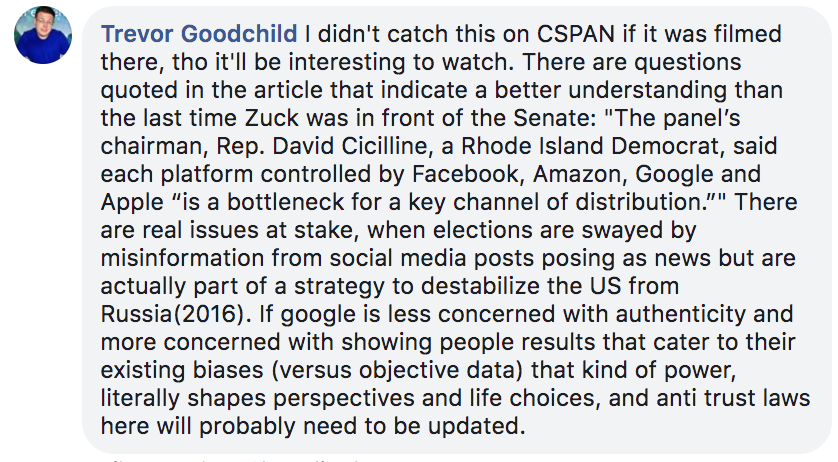
What's concerning is that if Google is filtering results from your Google searches to reveal less than the truth - this manipulates your perception of reality.

If Google search results only cater to their advertisers and things that support their platform - this is literally creating life choices for billions of people who view the same data as objective.

It wouldn't be an issue if there was a real space for other search engines to compete, but Bing is dead, Duck Duck Go is used by only a small minority and Yahoo search is a joke.

With Google being used by everybody...this is where being a monopoly causes issues:


How do you think antitrust laws should change in regards to Big Tech?

               .  .  .

Enjoyed this blog?
Signup here to get updates on new startup blogs.
Is Facebook not explaining why the disapproved an ad?
I worked at FB for years and offer FB Policy Consulting here

Available for freelance writing and guest posting on your blog: [email protected]

Trevor W. Goodchild

Remembering Why We Do This


It's easy to get stuck in auto pilot - even our reaction to the news, major events and business developments can be automated.

Whirling into chaos, we numb out and forget our big Why, for why we do this. Why we started a business, why we continue to try to improve it and ourselves and we we hope for positive change if everything seems to be burning like the Notre Dame.

When it rains we run outside to roll up our car windows, adrenalin spikes and that one task is all we focus on.

I feel like since the global shut down of cities, the echo chamber on C19 has become a little too dominating, and a message of hopelessness. The reality is, there are good moments that still happen.

Every day.

Pictured above is a man in New Jersey who used a sign to thank hospital workers for saving his wife's life.

"Thank you all in emergency for saving my wife's life," the man wrote on his sign. "I love you all."

The nurse who snapped the photo is Allison Swendsen, who later shared the photo on Instagram and Twitter, where it quickly went viral.

When you are running your own business, crunching numbers, fighting with Facebook when they disable your ad account for no reason at all - it's hard sometimes to touch base with reality.

It's tempting to get sucked into the negative news vortex as well. But we are more productive when we nourish heart smarts and take time out for self care.

We function better, make more informed decisions and see more options open when there is also a little extra inner space that comes from setting the intention to genuinely care about your community, your customers and yes...your self.

A friend of mine recently told me that she felt like with all my big plans, launching a second business, being mentored by millionaires in ecom, writing a book - that I had forgotten to actually love myself.

It felt like I was being put on the spot and forced to be vulnerable while my attention was more focused on impressing this attractive girl I went to UT with, telling her all my grand designs.

She had a point - and I took it seriously.

It wasn't something that I vaguely considered - I set a specific intention to meditate on this during a break in one of my work days building my eCommerce store.

I focused on good moments that happened in my life, the things I've accomplished that I can celebrate as being uniquely me. Not just college degrees or starting businesses but repaired friendships, kind acts for others and developing self awareness.

My heart, which was weighed down with over concern for national issues, the pandemic, people I couldn't help but want to save - felt a release. The attachment lessened to trying to change things I couldn't, at least at this moment.

Afterwards, I got some great news for my business and even better developments unveiled themselves for my new startup.

It isn't a coincidence - there is a causal relationship between our mind state and emotions, and the quality ranking of business decisions -personally & professionally.

According to the Harvard Health Blog, self-care through exercise changes the brain to improve thinking skills:

"Exercise helps memory and thinking through both direct and indirect means."

"The benefits of exercise come directly from its ability to reduce insulin resistance, reduce inflammation, & stimulate the release of growth factors—chemicals in the brain that affect the health of brain cells, the growth of new blood vessels in the brain, and even the abundance and survival of new brain cells. Indirectly, exercise improves mood and sleep, and reduces stress and anxiety."

"Problems in these areas frequently cause or contribute to cognitive impairment."

This is good to remember as we all teach ourselves how to cope with lockdown as discussed in Monday's blog.

Need ideas for how to change up your self-care rituals or want to start from scratch?

Here are 80 Self Care Ideas which include:

√ Journaling
√ Taking time for slow contemplative morning coffee
√ Bookclubs
√ Exchanging social media time for nature time outside
√ Getting up early and reading inspirational books

That man in New Jerz, with his simple sign but powerful message, was so affected by the work done by nurses at that hospital, and his wife's life was saved, that he took the time to share this message even with social distancing.

The nurses that saw this both on social media and at the hospital went to work the next day, even more dedicated to saving lives and feeling glad they are appreciated.

Turns out compassion is great for business.

So take a moment to reflect on why you should love yourself and appreciate the efforts you've taken to get here today.

This will improve your mood, reduce stress and help you make even more strategic choices with better outcomes in your business.

What experiences have you had that give you hope? Comment below!

               .  .  .

Enjoyed this blog?
Signup here to get updates on new startup blogs.
Is Facebook not explaining why the disapproved an ad?
I worked at FB for years and offer FB Policy Consulting here

Available for freelance writing and guest posting on your blog: [email protected]

Trevor W. Goodchild

Coping With Lockdown: Oil Plummets, Retailers Close for Thanksgiving


While Customer Service may be undergoing a makeover in light of recent protests, Target and Walmart are staying closed for Christmas this year. Dick’s Sporting Goods is also closing for Thanksgiving.

2020 is a year unlike any other with more rapid changes to business and the world as we know it.

The biggest shopping events of the year will take on a new tone now, as crowds are prohibited from gathering due to the rapid spread of the Corona Virus with over 16 million new cases globally. 

Giant retailers are encouraging consumers to shop earlier online for the holidays and promise to start sales earlier as well, according to Target's blog. 

Context is everything right now, this 2019 seemingly normal picture of what life was like shopping pre-C19 now, will trigger many emotionally, seeing people without masks at the checkout:


The year is flying by at super sonic speeds despite the feeling that time is dragging by extra slow, stuck at home and feeling cabin feverish.

The speed of major events that keep happening is making it hard to feel like we have had enough time to savor the moments, as each day can bring new challenges when adapting to life on lockdown.

This coming Monday U.S. Senate Republicans are expected to reveal a new $1 trillion coronavirus aid package. This could add more economic stimulus and perhaps even indicate a bull market trend for big oil who has been suffering losses due to reduced travel during the pandemic.

Per Reuters:

Brent crude LCOc1 lost 81 cents, or 1.9%, to $42.53 a barrel by 11:13 a.m. EDT, while U.S. West Texas Intermediate (WTI) crude CLc1 fell 65 cents, or 1.6%, to $40.64 a barrel.

Following the closures of consulates in Houston and Chendu, investors worried about relations between China and the United States and have retreated to safe havens, such as gold and bonds.
Is big oil partially responsible for Americans getting stimulus checks?

This is a good question, as the oil industry hasn't shirked donating millions to politicians in exchange for political favors in the past. This is part of what killed the electric car before Elon Musk brought it back through better brand definition and audience targeting.


The more money consumers have, the more likely they'll use that money to break the monotony of staying at home all the time and splurge on trips, drive more and oil companies benefit from this.

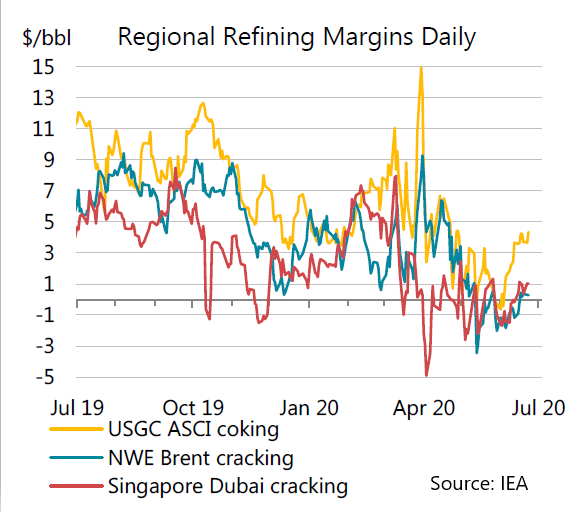
The oil industry is doing everything they can to find a way to survive right now as the margins for refined oil products have dropped into negative areas:

Source: IEA


To be fair, trading divisions can make money even when prices dip by exploiting choppy market moves.

Is it possible that these fossil fuel companies, out of self interest, are pulling the strings they have to pull to nudge politicians towards printing more Monopoly money out?

When the Terminator can become the governor of California and someone who is illiterate, unable to read at all can become president in 2016 - who is to say what's possible these days...

There is still the larger question of where we go from here, for a long term plan. There are greater things at stake micro and macro level.

I haven't been able to see my son for a long time, since Christmas in 2019 as the pandemic hit and the fear that either one of us is asymptomatic keeps his mother from allowing visitation. Will I ever see him again?

Many families are experiencing strife due to how things are panning out, unable to go back to work because daycares aren't open and schools are closed to only virtual classes.

Oil based capitalism is literally the backbone of much of America's economy. When the bottom drops out as the flow of petrodollars halts there are new problems: where do we put all this oil?

Three quarters of the world's storage capacity have already been reached and the limits were tapped back in May 2020 this year as The Petroleum Economist reports.

Another side effect is that Exxon, Shell, BP, and a handful of others — who are much better positioned to survive this crisis than smaller producers — are using the crisis to try to roll back environmental regulations.

So perhaps not quite the benevolent saviors their PR agents would have us believe they are. While it's easy to say things like, just go green with wind, solar and hydroelectric energy sources this ignores how entrenched oil as a commodity is in the stability of existing markets for the global economy.

One of the newest coping mechanisms of fossil fuelers is Russia may agree to a three-way arrangement with Saudi Arabia and the U.S. to limit output to halt the downward slide of oil product prices.

Previously, Putin was resisting any concessions in a stand-off with Saudi Arabia since Moscow pulled out of a supply-limit agreement with OPEC over demands for deeper cuts in output.

But the reality is this industry has to prepare for challenging times, low oil prices, and learn how to adapt like the rest of us to the rapidly evolving situation with the corona virus.

There is no doubt that political alignments are being reworked, and arrangements are being made to consolidate in the interests of the most powerful forces at work in the world.

I'd like to see the same desperate winner take all driving unstoppable force the fossil fuel industry has right now, also coming from renewable energy providers.

In the aftermath of the pandemic, there will be new winners and losers. I would like to see a more sustainable business model from green energy that creates new markets for both investors and consumers.

What changes would you like to see after C19? Comment below!


               .  .  .

Enjoyed this blog?
Signup here to get updates on new startup blogs.
Is Facebook not explaining why the disapproved an ad?
I worked at FB for years and offer FB Policy Consulting here

Available for freelance writing and guest posting on your blog: [email protected]

business blog, business blog, business blog

Customer Service with Gender and Racial equality


In my last blog we discussed the beautiful art of Guerrilla Marketing (really interesting read), but today let's shift to customer service. Specifically customer service with gender and racial equality in mind.

"Woah. Deep topic bro. You sure about that?"

2020 has seen a pandemic make businesses lose trillions of dollars, black lives matters protest take over cities across the nation and we have a presidential election while on lock down.

Yes, it matters right now, more than ever. Many businesses use outdated language and terms and conditions, not to mention how managers are trained as well as customer service reps.

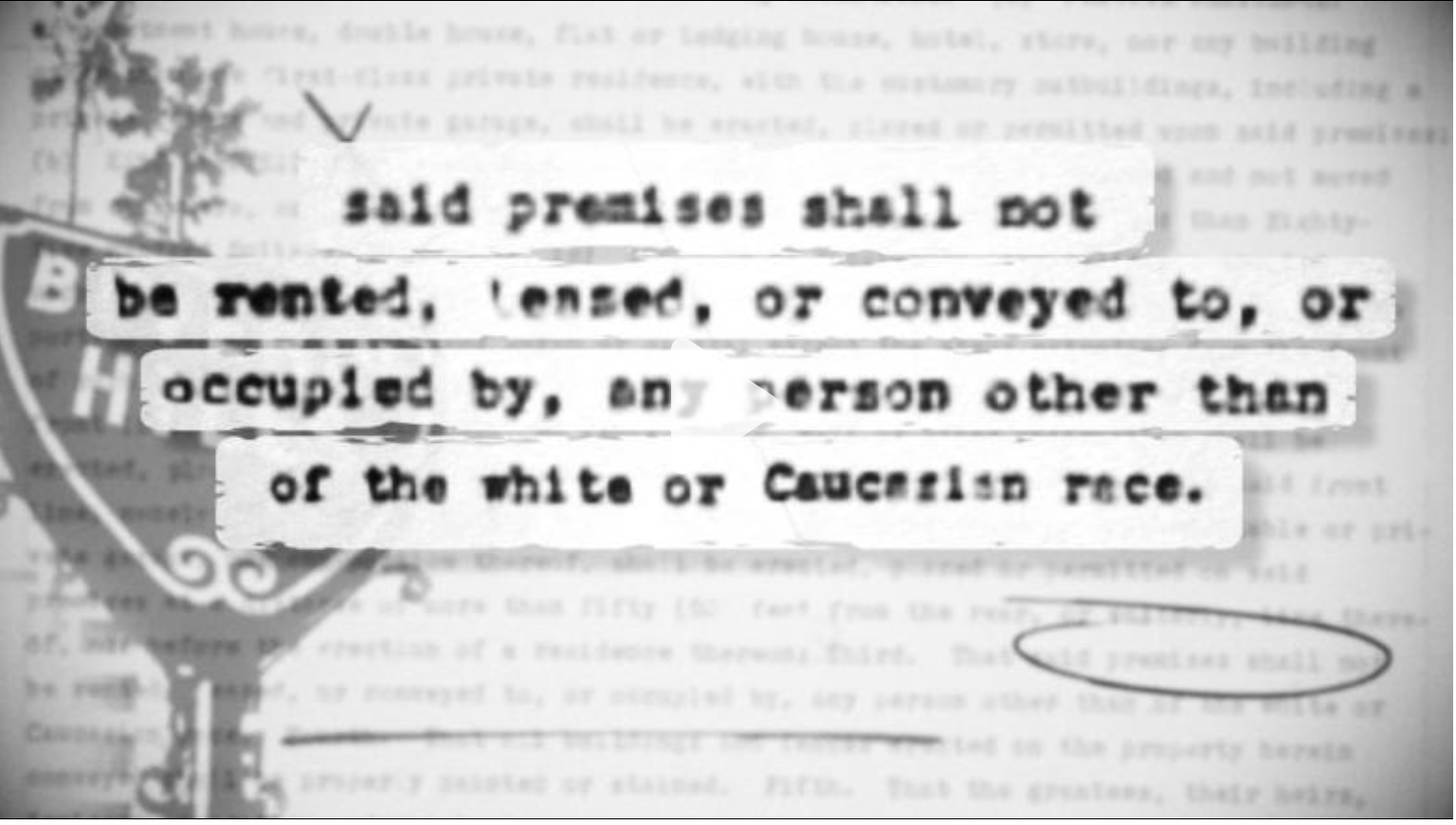
Did you know in certain leases, it still says you can't sell a house to a black person or a Jewish person? True fact as CNN reports here.


But your business doesn't have to be real estate to lose business because you're using outdated terms that may be prejudiced. You could be in any industry that hasn't keep tabs on how society has changed.

It always starts with the top down - the CEO and/or founder of the company sets the rules and regs in place that has a trickle down effect for how company morale is shaped.

As discussed in the break down of management strategies blog management philosophy in business hasn't changed since the 1800s - yet the world has changed dramatically.

While affirmative action and diversity hires are huge topics deserving of their own articles, it is telling us that there were huge gaps in how business and education operated and how we really live today.

How important is having customer service that considers gender and racial equality to your business?

As entrepreneurs, our ability to pivot and adapt to changing situations is how we continue to not just survive, but thrive, even in uncertain times.

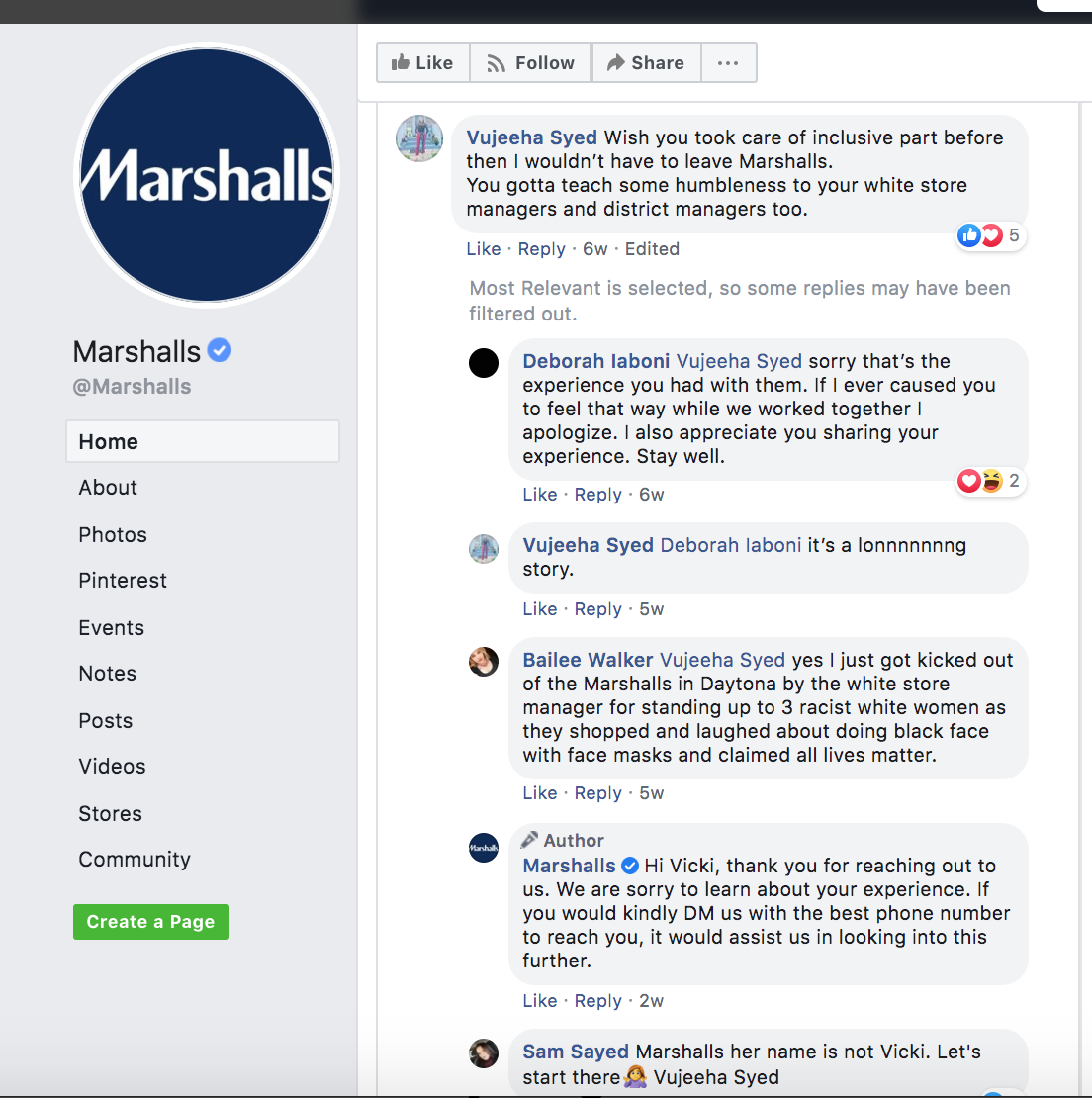
While doing market research for a new eCom business I'm launching, I came across Marshall's Facebook Page and it appears their customer service could use some tweaks.


I don't know how you can mess up more blatantly than this for customer service. By Americanizing an Arabic name into "Vicki" (when it was even spelled out right above Marshall's response) it was clear that customer service wasn't a priority.

Or even basic awareness. Most likely it was a response done by an underpaid employee who didn't have much motivation to even pay attention because he or she wasn't making enough money and didn't have training worth a salt.

As businesses move into digital and online storefronts only due to the pandemic, more sensitivity training is needed. Or just less bullshit. We have to realize just like texting, words don't convey tone.

This means for customer service, chatbots, live human chats, social media, websites, email outreach and more businesses will benefit from analyzing how their tone comes across to multiple perceptions.

Companies need to be aware if the public's perception of their business doesn't support racial and gender equality.

Regardless of your personal view points (which I hope allow everyone the same level of humanity), it is also about profit margins. Your business will lose money if you're still in the 1800s and the rest of the world has left you behind with 3D printers, air touch technology and social emotional awareness.

Are there any changes or focuses you are making with your business that are new in light of what's been happening in 2020? Comment below!
                         

                             .  .  .

Enjoyed this blog?
Signup here to get updates on new startup blogs.
Check out my Medium page here
Is Facebook not explaining why the disapproved an ad?
I worked at FB for years and offer FB Policy Consulting here

Available for freelance writing and guest posting on your blog: [email protected]

business blog, business blog, business blog

The Art of Guerrilla Marketing


Guerrilla Marketing is the ability to turn heads without an extremely large budget. According to Lexico Guerrilla Marketing is defined as:

Innovative, unconventional, and low-cost marketing techniques aimed at obtaining maximum exposure for a product.

It isn't what you'll learn about in a class on marketing from your community college or four year university. The key word here is unconventional.

PayPal Got Played By We Pay @ Their Own Conference

Have you ever heard of PayPal freezing a business's money randomly?  


It happens. A lot. CNN Business descriptively states:


While it's supposed to be a measure to protect users against fraud, more often than not it has hurt businesses finances a lot. One person was raising money for cancer treatment when PayPal froze his account. Do a simple google search for 'PayPal froze my money' and you'll find thousands of results:


Pay processors and the drama they sometimes cause for entrepreneurs deserves a whole blog unto itself, but going back to Guerrilla Marketing, there are new competitors to PayPal every year. One refused to stay quiet.

One of my favorite examples of Guerrilla Marketing is when the payment processor We Pay dropped a 600 pound block of ice, with hundreds of dollars in it at PayPal's developer conference, at the Moscone Center in San Francisco. The message was clear:

“PayPal freezes your accounts” and that you should “unfreeze your money”… by switching to WePay.

Credit: https://techcrunch.com/2010/10/26/wepay-ice-paypal/


According to Hubspot this increased revenue for We Pay significantly:

• Conversions on landing page 3x higher
• 300% increase in weekly traffic
• 225% increase in signups

But Guerrilla Marketing isn't just pulling pranks it's being prepared for increased traffic and having a framework set up ahead of time to benefit from it. We Pay's achieved this by having a dedicated landing page for its stunt.

The WePay team had prepared in advance for a peak in engagement. They were ready for more emails, calls, and tweets than normal. And they had fun with it, documenting everything with pictures.

Carrie Remake Telekinesis in NYC Coffee Shop Stunt

In 2013, a marketing stunt to promote the remake of Carrie, a horror film from the Steven King book of the same name, pushed Guerrilla Marketing to a new level. A crazy telekinesis stunt was pulled on unsuspecting New Yorkers just trying to get a cup of coffee:


Needless to say, it was effective in getting the word out about the upcoming October 2013 film. While it could be argued that this ploy didn't perfectly fit the definition of being cost-effective

-I mean staging a telekinetic action scene in real life is rather elaborate-

I say it still counts as Guerrilla Marketing. Guerrilla Marketing stunts are risqué, highly visible, and attention-grabbing - all of which the Carrie NYC coffee shop captured. Hard to top that!

Carrie Foursquare's SXSW Tactic Added 100K New Users


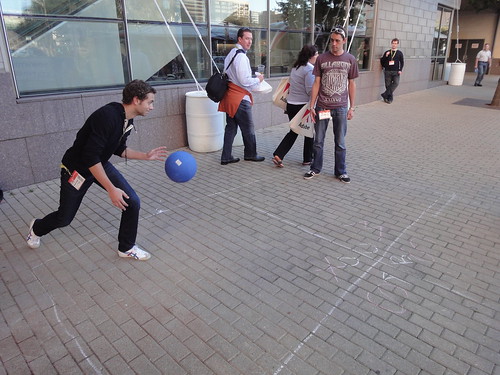
On the balling-on-a-budget level, the company Foursquare, which popularized the concept of real-time location-sharing and checking-in, played an actual game of Four Square at SXSW in Austin, Texas in front of the convention hall.

Credit: https://www.zdnet.com/article/playing-four-square-with-foursquare-at-sxsw-2010/


The game drew 1000s of walk-up participants, said Dennis Crowley, CEO of the firm. While the company co-hosted a party Monday night, Crowley said, its SXSW presence didn’t include other bells and whistles like signage or a booth in the hall. It largely hinged on “a box of chalk and two rubber balls,” he said.

“We played all day long, and there was always a waiting line,” Crowley said. “We were handing out tee shirts, buttons, and stickers. Anytime someone didn’t know what Foursquare was, we helped them find it on their phone. We helped get them up and running and using it.”

Foursquare benefited from an additional 100,000 checkins that Saturday they played the four square game at SXSW on. Ever wonder why you see an ad for a store after walking by the store?

Since 2014, Foursquare launched Pilgrim, a piece of code that passively tracks where your phone goes using Bluetooth, Wi-Fi, GPS, and GSM to identify the coffee shop or park or Thai restaurant you’re visiting, then feeds that data to its partner apps to send you a 10 percent off coupon if you leave a review for the restaurant.

Today, Pilgrim and the company’s Places API are an integral part of tens of thousands of apps, sites, and interfaces. As Foursquare’s website says, “If it tells you where, it's probably built on Foursquare.”

While there are privacy concerns using Foursquare and it's technology, that game of four square they played was a great example of low cost Guerrilla Marketing.

If you want to use Guerrilla Marketing for your business here are a few tips:

• Keep your strategy fun, simple, and witty.
• Physically travel to the influencers in your target communities.
• Engage influential bloggers through mutual plugging.
• Flatter your audience. Always make them look good.
• Make social phenomena the core of your campaign.
• Be outrageous.
• Dare your audience to test your services
• Create a viral video that is humorous and pokes fun at yourself.
• Leverage existing communities, events and platforms.
• Impress people who can grow your business thru their audience.
• Create controversy by challenging your competitors. Credit.

How can you use this strategy in your business? Have you seen Guerrilla Marketing happen in real life, or have a favorite example yourself? Comment below!
                         

                             .  .  .

Enjoyed this blog?
Signup here to get updates on new startup blogs.
Check out my Medium page here
Is Facebook not explaining why the disapproved an ad?
I worked at FB for years and offer FB Policy Consulting here

Available for freelance writing and guest posting on your blog: [email protected]

business blog, business blog, business blog

The 5 Traits of Emotionally Intelligent Business Leaders

Credit: Morning Brew


In the unprecedented changes we all face right now, it is sometimes unavoidable that workplace stress may rise. If you're keeping up with my blog you're employing top level SEO tips now but still may be getting stressed at work.

The usual suspects are interoffice politics conflicts, changes to how work is done or departmental shifts and of course new changes in technology (we can video chat now but still can't get the computer to load fast).

According to National Center for Biotechnology:

"Stress-inducing management practices included unrealistic demands, lack of support, unfair treatment, low decision latitude, lack of appreciation, effort–reward imbalance, conflicting roles, lack of transparency and poor communication."

While businesses can't control global pandemics, interpersonal conflict can be managed more effectively. Work-related stress is decreased the higher the emotional intelligence is of those most affected.

What is Emotional Intelligence, Exactly?

But before we dive into skill sets, let's get on the same page on what exactly Emotional IQ is.

According to dictionary.com Emotional intelligence is defined as:


Psychology Today defines Emotional Intelligence as:

Emotional intelligence is generally said to include at least three skills: emotional awareness, or the ability to identify and name one’s own emotions; the ability to harness those emotions and apply them to tasks like thinking and problem solving; and the ability to manage emotions, which includes both regulating one’s own emotions when necessary and helping others to do the same.

Why Is Emotional IQ Important In Business?

Whether you're the CEO of a company, a mid-level manager, or an employee, those who are high in emotional intelligence are better able to manage their emotions and the emotions of others around them.

This adds tools which allow them to be more effective managing pressure at work.

Below you'll discover:

5 ways that emotionally intelligent people handle work-related stress better


1.  Amygdala Reactions Traded for Neocortex Responses

Ever been told to think before you speak, and thought, "What a novel concept, I'll do that of course!" and find yourself blurting something out later that you didn't intend to?

Emotions run much faster than thoughts and in certain moments like during road rage, we can literally see red when they overwhelm us.

On average, it takes around 6 seconds for our "thinking brain" also known as the frontal neocortex, to receive the same info that our "feeling brain" or amygdala gets first. You can see how this may cause a problem when attempting to respond reasonably right?

What happens often when we overreact is that there is a surge of emotions that is bigger than is really appropriate for the situation that floods our body.

So that moment when someone cuts you off, then goes slower than the speed limit (can you feel yourself reacting even right now?) is triggering the emotional brain to react first, within 10 seconds you can stop the rollercoaster of reactions when you think about how much more your life is worth than getting even with the one who cut you off is worth. That's your neocortex reasoning out cost benefit analysis.

Credit: https://nba.uth.tmc.edu/neuroscience/m/s4/chapter06.html


Here's the key: if we don't react right away, our neocortex's thinking process is activated which helps us make better decisions weighing out multiple outcomes of different actions.

2. They Know When to Take 5 to Gain Perspective

The brain is going to do what the brain is going to do - but emotionally savvy workers and management understand when their stress levels reach a peaking point where self-control starts slipping.

Business leaders and workers that are emotionally intelligent - and actively working on tuning in to this - get a lot more out of emotional energy expended at work. They intuit when breaks are needed to get space between a situation and their reaction to it.

3. They Name Names - in a Good Way

Another feature of emotionally intelligent business owners is that they know sometimes it is best to name the emotions they are feeling. This takes the bite out of the insta-reaction mode.

It can also be humorous to name an overreaction out loud - and humor is a great diffuser of tense situations.

4. High Emotional IQ People Identify Triggers & Respond Calmly

You aren't able to de-escalate a tense situation if you don't know what is creating the tension. One of the huge benefits of having a higher emotional IQ is being able to ID specifically what is triggering tense reactions.
Knowledge is power: once you realize what is setting you off, instead of reacting with anger because you were caught off guard, you can stay calm, positive, use active listening and set boundaries.

5. Emotional Intelligence Lets You Know When to Open Up

There are two extremes you may see in the workplace:

a) A co-worker or employee tells you their entire life story the first time you meet

b) A boss or work colleague never reveals how they are feeling, you walk on tip toes or don't interact at all

Finding a balance between these extremes involves knowing when to open up and become vulnerable to increase work cohesion which also furthers productivity.

Having higher emotional intelligence allows one to be aware of interpersonal relationships and signals when to enforce the company standards uniformly and when to humanize an interaction with empathy and understanding.

Deadlines might not be met, sometimes projects don't go as planned, other moments the wrong person is blamed for results not being ideal because another person wasn't pulling their weight.

Cultivating the capacity to not respond the same way to all external stimuli, like a robot might, but sensing both when showing a little vulnerability yourself is appropriate and when being open to others sharing as well is a function of emotional intelligence.

This ultimately improves teamwork, creates tighter knit workplace communities and reduces stress in interpersonal interactions. Authenticity is more than a buzz word - it makes one more relatable as long as you walk the walk you talk.

How can you use this strategy in your business? What situations have you seen benefit from the features of emotional intelligence described in today's blog?
                                              .  .  .

Enjoyed this blog?
Signup here to get updates on new startup blogs.
Check out my Medium page here
Is Facebook not explaining why the disapproved an ad?
I worked at FB for years and offer FB Policy Consulting here

Available for freelance writing and guest posting on your blog: [email protected]

business blog, business blog, business blog

How to Use SEO to Drive More Sales


One of the pain points small to medium sized businesses have (& even Fortune 500s in some industries) is not understanding what SEO is, and feeling it’s too technical.

Search Engine Optimization is in essence, how to get your website to rank on google searches when your prospects are searching for your product or service.

BUT there are even more benefits to keyword research that will be revealed below.

Keyword Optimization in a Nutshell

Let’s first get clear on the specifics of what SEO is:

Search Engine Optimization discovers which specific terms potential customers search google with to find a service or product.

How money is made through search terms is by including these same search terms on your website. This gets your website ranking higher on Google search results.

But – you need to know the exact phrases as well as words, and that’s just the beginning.

Beyond SEO

Finding those keyword terms is absolutely necessary to get your website content to rank higher on search engine ranking pages (SERPs). Also, you’ll want to be on page 1 of Google for search term search results because people rarely look beyond page one.

Yet, there is a level deeper you’ll want to go for maximum benefits:

Customer intentions when googling. When you know why your prospects are searching for things as part of the customer experience you expand your opportunity for upsells & downsells as well as where and how to build out new products and services.

For more info on how to improve your business by understanding the customer experience read this metrics blog here.

Making keyword research a regular habit you do for your business helps understand how your audience views the world, which enables your messaging to be more on point with better customization and personalization. This generates better trust in your business too!

Have you ever made a content map? I linked a nice Hubspot article to the words ‘content map’ to peep, it’s great to map out your blog content & social media posts ahead of time.

Integrating SEO into how you map out your content calendar will boost your business presence online and up your game by a whole bunch, as more of your audience will read your blog and consume your content when it is already planned with SEO in mind.

Bullet Point Your Search Terms

Step One: Brainstorm Likely Terms Your Audience Searches For
Just start thinking up the type of terms your audience may search for when looking to hire your type of service or buy your type of products, when Google searching.

It can be helpful to role play what you would do if you were a customer, or what you already do personally, when googling for a product. Write down those search terms. If you have a team, get their thoughts too. Think of how your customers may phrase things.

Step 2: Validate Search Terms With Reality
Go on Quora, google your keyword term plus forum or blog or articles and you’ll find where online conversations are happening about your topic. This will get you the exact words your customers are using.

For example, if you run a podcast or marketing firm search “podcast+board” or “marketing+forum” or vice versa, and you’ll find forums and bulletin boards where folks go to find more info. It’s a great place to get your finger on the pulse of current trends.

Pro-tip: Look at Wikipedia, enter your search terms, and look at the table of contents on articles that pull up. This will get you some new search terms that be even more clutch.

Step 3: Google Autofill Hack
This is a nice little hack even millionaires I work with in eCommerce didn’t know about until I taught them! Go to Google.com and enter in the first word of a keyterm — don’t type in the full phrase though let Google autofill the rest.

This is the genius of it, Google will suggest the most popular search term combos that people search for. This will advance your search term list with real results you aren’t guessing on but have in specifics.


Bonus: Google Search Console
Stroll over to the Google Search Console to see the keywords your website already ranks for. Google will also give you the heads up if you have broken pages and/or links on your site, or anything that prevents them from properly indexing your webpage on search engines.

The Genius of Long-tail Search Terms

At this point, if you’re following the steps outlined in today’s blog, you’ll have quite a few search terms written down from:

√ Your brainstorming
√ Role playing as the customer
√ Your teams ideas on search terms
√ What you find on forums and boards in your industry and
√Google auto fill suggestions

To be effective you’ll want to have four to six baseline key phrases.

Ex: Marketing, marketing strategy, marketing plan and eight to twelve long-tail phrases.

Ex: Marketing plan template, Marketing help for small businesses, Marketing ideas during covid.

Baseline search term phrases are just that, your baseline. Start with these, put them on your landing pages, even in About pages if you can.

Use one phrase for your home page and the other phrases should have landing pages or whole sections of your website dedicated to these terms.

This empowers you to earn rankings on search results on Google. But make sure when choosing baseline key words to include relational search phrases in addition to the main one.

What I mean is this, remember when we talked about intention and the customer experience? The plain picture search term of say “marketing” will have higher competition than a less-than-obvious search term that denotes the experience your customer has on the customer journey.

An example of a key word phrase that reflects intent would be “get leads for my business” instead of just “marketing.” It’s a more specific intention which separates the people who may also be marketers from your customer base, that you actually want to reach.

As you may have noticed, the second phrase is a long-tail search term.

The long-tail search terms are fantastic on clarifying the customer’s intention, like the “getting leads for my business” above. You can even make certain weeks in the month themed for specific long-tail search terms you want to split test for SEO generated traffic on your site.

Sounds pretty dang useful right?

There are a few tools SEO experts recommend using I’ll mention as well.

SEO Tools Experts Use

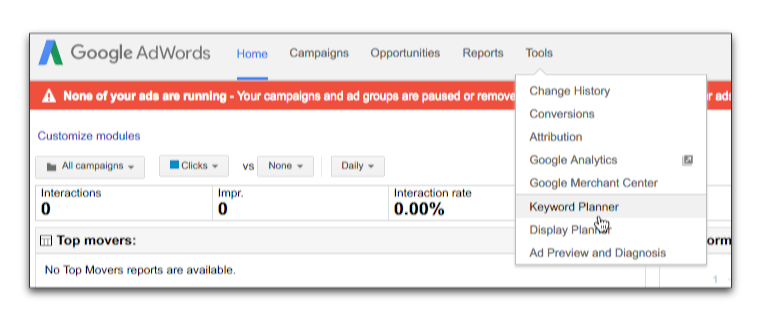
Google Keyword Planner

gkp


Try and use your twelve to fifteen search terms in the planner’s keyword suggestion tool, and peep the ad groups Google suggests to piece out and label what you see.

You can find terms related to the ad groups, and view the estimated search volume for each term and the suggested bid — keep in mind it’s an AdWords tool made mainly to sell more ads.

Keep your perspective balanced here, as search volume is just one metric. Search terms with a lot of traffic don’t always help, but when you marry this to the bid price, you’ll notice high bid price means higher conversion values.

It isn’t a hard fast rule, but you’ll begin to see that bid price fluctuations are a vital sign when diving in to the research. Ideally, you want to mark and edit your search phrase with a combo of search volume and bid price. Try to find the mid point.

If you’re feeling overwhelmed right now – it’s understandable. You can stick with all the advice given before the Tools section here and still come out on top, better than before.

Here are a couple of other tools SEO experts recommend:

Yoast Suggest
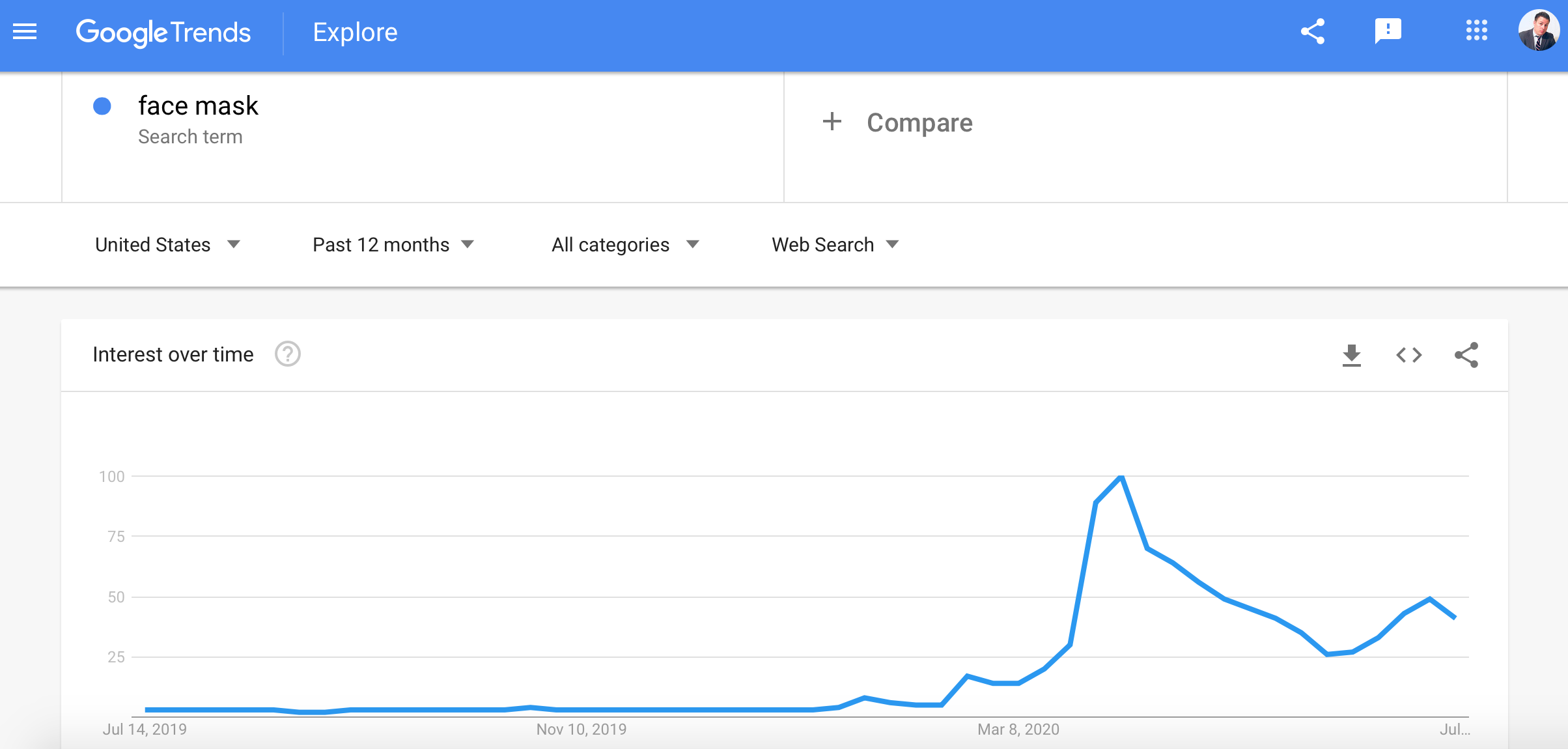
Google Trends

TLDR Cliff Notes Version: Yoast is a free WordPress plugin (with advanced options on the paid plan), it alphabetically lists related search terms from Google, and Google Trends is gold for seeing a timeline of the popularity of a search term.

Google Trends is key if you plan on running Amazon or Shopify eCommerce businesses, as you can see spikes, dips and plateaus for search terms ( = buying habits) of a product you’re evaluating for adding to your shop.

face mask SEO google


What are your favorite key takeaways from today’s blog on SEO? Comment below, thanks.


                                              .  .  .

Enjoyed this blog?
Signup here to get updates on new startup blogs.
Check out my Medium page here
Is Facebook not explaining why the disapproved an ad?
I worked at FB for years and offer FB Policy Consulting here

Available for freelance writing and guest posting on your blog: [email protected]

business blog, business blog, business blog

Dakota Access Pipeline Court Ordered Halt


Sometimes a business losing out is a good thing for the global impact. Not every business is well adapted to current times and sometimes the market needs certain business models to die out to make way for something better.

As retail businesses learn to adapt so they don't close, the oil industry which is responsible for millions of deaths, wars, and occupation, is struggling as well.

You may have forgotten with the huge headlines coming and going in rapid succession, from Black Lives Matter protests to covid craziness, that the Dakota Pipeline threatened the livelihood of thousands native to the planned development site.

Dakota Access Pipeline TLDR History

Informational hearings for landowners took place between August 2014 and January 2015. Dakota Access, LLC, controlled by Energy Transfer Partners, started constructing the pipeline in June 2016 and cost $3.78 billion dollars.

Protests of the Dakota Access Pipeline occurred at several places because of concerns about the pipeline's impact on the environment and to sites sacred to American Indians. Indigenous nations around the country opposed the pipeline, along with the Sioux tribal nations.

The Obama Administration spoke out for the need to analyze environmental impacts more, then later President Trump did his best to fast track the pipeline into operation. Trump signed a presidential memorandum to advance approval of pipeline construction.

Then the Cheyenne River Sioux sued this decision, citing an 1851 treaty and interference with the religious practices of the tribe.

The pipeline goes underneath Lake Oahe, a water supply source for the Sioux Native Americans. The pipeline became active May 2017, despite almost 15,000 people from around the world protesting, staging sit-ins for months near the Standing Rock Indian Reservation.

The pipeline commercial operations started without oil spill response plan for the Missouri River crossing and without emergency response cleanup equipment stored nearby.

Jesse Jackson called the move to put the pipeline closer to the reservation, "environmental racism," as ABC News reported. But the plot thickens like a cup of day old coffee - why would Trump be so eager to support the pipeline?

Trump's 2016 federal disclosure forms show he owned between $15,000 & $50,000 in stock in Energy Transfer Partners - the company in charge of constructing the pipeline - per Al Jazeera.

Surprised? There's more. Energy Transfer Partners CEO Kelcy Warren gave $103,000 to the Trump campaign, as Reuters reports. Despite how crazy this sounds already it gets even crazier with Russian hackers.

Russian government's Internet Research Agency Troll farm spread misinformation on social media sites like Facebook, Twitter and Instagram by creating a fake Facebook Page to enrage people with posts about the pipeline, same sex marriages, and racial issues.

As far as a business model, the oil industry is definitely anachronistic, as surveying your customers for what they like and giving it to them is one of the fundamental ways to grow your brand.

This isn't exactly a strategy being used here. But, there seems to be a positive turn of events. Well, not positive for the oil industry, but positive for the people it affects.

Dakota Access Pipeline Court Ordered Halt

Reuters states:

According to the ruling, the U.S. Army Corps of Engineers violated the National Environmental Policy Act (NEPA) when it granted an easement to Energy Transfer LP (ET.N) to construct and operate a segment of the oil pipeline beneath Lake Oahe in South Dakota, because they failed to produce an adequate Environmental Impact Statement (EIS).

The court ordered Energy Transfer to shut and empty the 570,000 barrel-per-day (bpd) line within 30 days, closing off the biggest artery transporting crude oil out of North Dakota’s Bakken shale basin to Midwest and Gulf Coast regions.

My Take

It is a complicated issue, at least the shutting down part is. While most people not either getting bribes from the oil industry as Trump was blatantly benefiting from or working for the oil corps, would agree that it's not good to endanger the water supplies of local residents, closing down the operations faces additional complications.

First, many jobs will be lost for those working the pipeline, which will cause a loss of economic stimulus from those workers spending their money in the local economy as well as their own struggle to survive.

Second, there will be a question of retaliation from the oil industry. This could take the form of people they hire to sue, or get elected and pass laws hurting Native Americans or other black hat tactics.

Third, it's going to be complicated trying to get the oil in the pipeline now, out of it, and transported elsewhere. It's likely the unused oil will be transported via rail cars to the west and east coasts.

So hey if you own a rail car company - there is some money to be made with this shut down. Many environmental and locals to the area are super relieved and happy to hear this news.


But, there are other elements at play that while working against the oil industry, in a way, soften the blow to their business, in that, oil consumption nationally is already at an all time low.

This is because of covid, people are staying home more, going out less, and using their cars a whole lot less. In addition to individuals, large events people drive to are canceled. 

Those high school and college graduations that were canceled also mean thousands if not tens of thousands of relatives of graduates, especially in college, who live out of town, aren't driving to their family's graduation ceremony. 

There are many other examples of where and how both individual car use and public transit and cross country bus transit are down.

Now, in the aftermath of the Dakota Pipeline shutting down, there will be less oil consumption, yet, we already weren't using as much oil as pre February 2020 this year. So..does it matter that much anyways? 

Ideally, society as a whole would have shifted before now to more renewable sources of energy due to countless studies on the global impact of fossil fuels. It's just hard to convince established industries, with deep pockets and large contributions to politicians who pass the laws regulating oil to switch to going green. 

Perhaps this is the push we needed to ramp up infrastructure around sustainable energy? I don't know. But I do know thousands of Native Americans are happy their water supply and burial grounds aren't threatened anymore. 

This just brings up the important point to think about: if your business model involves harm to other people and the environment, it is time to rethink how you're strategizing for the long term. Certain businesses should be allowed to die.

Operating a business that has longevity means your marketing plan and long term strategy is just as responsive as site optimized for mobile viewers and social media presence.

The values that your company publicly demonstrates is the most attractive value proposition or unique mechanism think tanks can come up with. After all, like attracts like.

                                              .  .  .

Enjoyed this blog?
Signup here to get updates on new startup blogs.
Check out my Medium page here
Is Facebook not explaining why the disapproved an ad?
I worked at FB for years and offer FB Policy Consulting here

Available for freelance writing and guest posting on your blog: [email protected]

business blog, business blog, business blog

In the Struggle to Survive There is Hope

Credit: Morning Brew


Before the Corona Virus hit and lock stock and barrel shot retailers in the face, brick-and-mortar businesses were already struggling. Several national chains closed down stores in rapid succession like Radioshack, Sears and Blockbuster.

While Tesla is booming in business, retail establishments still face challenges.

Now that stay-at-home orders are in place everywhere, and at best you may have 50% capacity allowed at restaurants, retail businesses need to recalibrate their strategy.

The wait-and-see if things get better approach isn't going to do anyone any favors at this point. We are 5 months into the new now. Graduations canceled, weddings forestalled, schools everywhere moving to remote learning.

McKinsey reports that consumers are more likely to keep many of the habits developed on lock down even after everything returns to normal. (Fingers crossed this actually happens).

In the Struggle to Survive There is Hope

While this does present new challenges, it also presents new opportunities. The masks, social distancing and occupation limits are pushing many businesses who resisted building a digital presence into either going out of business or putting their storefront online.

The bright side of this, is that it is a catalyst for many companies who would have otherwise slowly faded to the background and quietly closed their doors.

With Amazon competing as the largest general store, eBay, and more taking business away from store fronts across the world - now these same businesses are back in the game so to speak.

Being forced to sink or swim right now has helped many companies finally get up to date with creating an online store, meaning they have more opportunities to attract business than if they just stayed analog. 


Brand loyalty isn't just an optional strategy - increasing the quality of the customer experience is now super vital to get customers to come back for repeat business.

Offering consumers options for ordering and picking up at the store, and ensuring their websites are mobile friendly are only a few of the adaptations businesses have to go through to survive.

As much doom and gloom as you read in the media, I take this as a good sign because it's pushing some businesses who would have gone out of business in the next couple of years to adapt in new ways that ensure their survival.

There's a taco shop I love who never posted on Facebook before COVID struck and now I can see their specials on their Page, as well as updates to their (rather outdated) website.

Customers can get more info ahead of time on what's on the menu, increasing the chance of this restaurant being where they have lunch today.

It's just one of many examples of how the threat of COVID closures have upped the ante for companies that would otherwise not have tried to go digital.

I see many businesses developing their social media presence now that straight up left their Pages dusty before.

The result is I'm seeing more B2C social interactions, peer support, more accurate reviews, and recommendations, lots of multimedia content, more personalization and an opportunity to build in gamification to the customer journey.

What positive changes have you seen in businesses that are new to right now? Comment below!


                                              .  .  .

Enjoyed this blog?
Signup here to get updates on new startup blogs.
Is Facebook not explaining why the disapproved an ad?
I worked at FB for years and offer FB Policy Consulting here

Available for freelance writing and guest posting on your blog: [email protected]

Trevor W. Goodchild

Tesla’s Stock is Up – Elon Exceeds Expectations

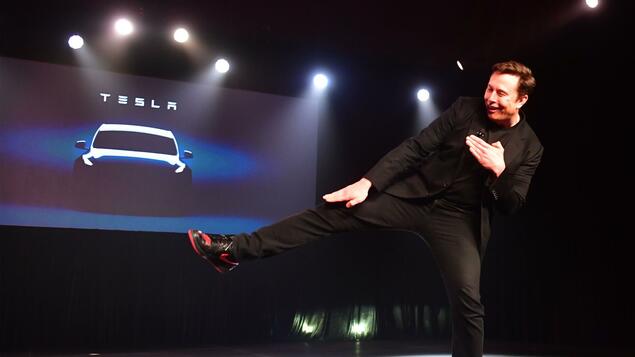
Credit: Tesla CEO Elon Musk during the unveiling of the new Tesla Model Y in Hawthorne, California in March 2019. Photo: Frederick J. Brown/AFP, via Getty Images


The Tesla cars are like certain bands, either you love them or you hate them. Investors have been casting a dubious eye wondering how Elon Musk's car company will fair give COVID.

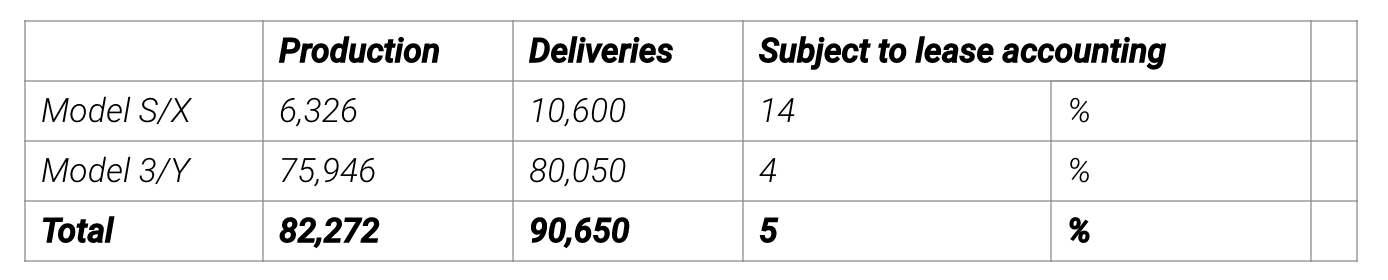
Tesla delivered a total of 90,650 vehicles during Q2 of 2020. This is an astounding 2,250 more than in the first quarter of the 2020. 82,272 Tesla cars were produced April to June this year, which is down from Q1 because of C19 holdbacks.

“While our main factory in Fremont was shut down for much of the quarter, we have successfully ramped production back to prior levels,” Tesla wrote during their Q2 announcement.

Credit: https://electrek.co/2020/07/02/tesla-announces-q2-deliveries-90650-electric-cars-beating-expectations/


Tesla Stock Rises

Audi just reported a more than 30% drop in deliveries in Q2, so Tesla is definitely ahead of the curve. Tesla’s market valuation is just over $224 billion (as of the date this blog is published).  

Tesla has also passed the market caps of Dow components Coca-Cola (KO), Disney (DIS), Cisco (CSCO), Merck (MRK) and Exxon Mobil (XOM).

Tesla was predicted by CNBC analysts to deliver only around 70K and well over shot low expectations. As a result, Tesla's stock is rising. TSLA is up $100 (9%) trading at $1220 pre-market value (as of July 2nd, 2020).


Elon Musks's electric car company is showing great headline numbers for an auto industry struggling to make profits on new car sales due to the pandemic. Some of this is attributed to Tesla entering China as a manufacturer, when prior, Musk had only sold Teslas there.

The Secret to Tesla's Success

Tesla shares are on a bull run now even in spite of the economic downturn the world is facing, and this is largely possible because Musk understood how to dominate a niche market.

It wasn't just about going green, but targeting a market of buyers who wanted to go green without losing the class and style this level of luxury vehicles offer.

Just like Tuesday's blog reported that there is something beyond the surface at play, with how the Facebook algorithm prioritizes content, Elon Musk didn't just sell an electric car. He sold a lifestyle.

There are many lessons other automobile manufacturers and startups can learn from analyzing the rise of Tesla's success. Clearly cheap gas prices right now don't offer an incentive to buy electric cars.

Many sustainable energy companies that provided wind and solar options never survived, and this was largely because their marketing strategy depending on everyone just realizing going green is the right thing to do. 

Elon Musk focused on dominating a single niche of wealthy-ish suburbanites who wanted to support renewable energy but not sacrifice aesthetics in the process. And his strategy is succeeding.

How can you use this strategy in your business? What sub niches exist with your main target audience that have potential for new products to serve their interests?

                                              .  .  .

Enjoyed this blog?
Signup here to get updates on new startup blogs.
Check out my Medium page here
Is Facebook not explaining why the disapproved an ad?
I worked at FB for years and offer FB Policy Consulting here

Available for freelance writing and guest posting on your blog: [email protected]

business blog, business blog, business blog

Does Facebook Only Promote Sad Reacts? No – It Goes Deeper


The content that you see on social media, or Facebook at least, is not as random as you may think it is. The Facebook algorithm is how Facebook decides which posts users see, and in what order, every time they check their newsfeeds.

Credit: Hootsuite.com


In the early days, when the Facebook algorithm was born, in 2009, posts were sorted based on popularity.

But, after more time passed, Facebook decided to just do what ever they could to keep Facebook users on the platform. The reasoning is that the more time Facebook users are on Facebook, the more they can be advertised to.

Right now there is a lot of negativity on Facebook. There are positive posts too but many news articles state that negative talking points are organically being supported more than positive by the Facebook algorithm.

While Facebook is free to use, Mark Zuckerberg pays the bills through advertisers paying him ad money to run advertisements on the platform.

The more time people spent on Facebook, the more money goes to the shareholders 
of Facebook.

Facebook's Shareholders

Mark Zuckerberg, with a net worth of $54.7 Billion dollars according to Forbes, holds over 400 million shares of Facebook, comprising a market value of around $82.2 billion.

The Vanguard Group Inc., an investment management company, holds approximately 184.0 million shares of Facebook with a combined market value of about $37.7 billion.

BlackRock an asset and investment management firm, holds about 158.2 million shares of Facebook with a combined market value of $32.3 billion.

FMR LLC, a financial services company holds approximately 123.6 million shares of Facebook with a combined market value of $26.1 billion.

T. Rowe Price is an investment management company offering portfolio management, equities, fixed income, asset allocation, and holds about 107.8 million shares of Facebook totaling a combined market value of $22.1 billion. Source: Investopedia

Facebook Algorithm Changed to Prioritize Friends & Fam


Mark Zuckerberg announced in 2018 that going forward, one of the biggest changes with Facebook was that the algorithm would be modified to prioritize friends and family posts instead of just advertisers' posts.

However, that's not what happened. Instead of seeing more communities of friends and families created, studies revealed that over 50% of increased engagement was paired with increased divisiveness, outrage and angry reactions.

At the same time, the way the Facebook algorithm prioritized content ended up supporting fringe posts on fake news from scam artists and spammers who knew how to work the engagement algorithm.

If It Bleeds It Reads

Journalism, in the news media has always had a slant for things that are negative. Despite the fact that there are also more positive topics that are newsworthy -- these are often ignored to prioritize the shock and awe and graphic violence stories.

So much so, there is even a catch-phrase that journalists use: “If it bleeds it reads.”

In a sense, Facebook has just allowed itself to become prey to the same ideology with one big predator creating the most amount of unhappy feelings in millions of people’s lives as they scroll the newsfeed: Fox News.

“Angry” is the top reaction when it comes to political content, though not other types of content. Fox News hired social media managers who knew how to bleed the hearts of millions through divisive negative stories on Facebook:

Credit: newswhip.com


It's clear Faux News knows exactly what they are doing, and do it well. Creating content that is negative and hateful will get more reactions, with a consistent narrative, posting schedule and relentless factory of discontented posts.

That's not the entire story though. There are plenty of other stories and posts that have gotten a high number of reactions that are positive. Posts about babies, pets, and baking cookies also have gotten incredible amounts of reach.

Over 2 MILLION engagements were drawn to the So Yummy Facebook Page's post on 12 cookie decorating hacks:

Credit: newswhip.com


So while many decry Facebook as having the intention of hurting people's feelings and spreading discontent, this isn't reality. Reality isn't one single narrative. When you subscribe to only one way of thinking you miss out on what's happening in the periphery.

The reality is, Facebook is a tool, and if bad characters spend more time on learning how to use this tool and get more adept at distributing content with higher engagement - they will dominate the Facebook Newsfeed.


Credit: Anthony Quintano


What's curious is how many people seem to miss out on the fact that reactions such as the laugh react and love react, if prioritized in high numbers also drive just as much engagement on Facebook.

The narrative that keeps getting repeated is that Facebook is only supporting negative content, when studies by NewsWhip for instance, show this simply isn't true.

NYU professor Scott Galloway, who is known for his outspoken views on Facebook - and someone whose perspective I value - has also missed this essential fact as well in a recent interview with Fast Company:

"What these companies [eg Facebook] have done is created a business model where the most incendiary, upsetting, controversial, and oftentimes false and damaging things get more oxygen than they deserve because we are a tribal species and when people say things that are upsetting we tend to engage. Engagement equals enrichment. The more rage equals the more clicks equals the more Nissan ads. So these algorithms have figured out that if you promote the flawed junk science of anti-vaxxers, it increases shareholder value. There is a population of people out there that believe vaccinations are bad, and they should be heard. But they should not dominate health news so that you start getting these stories from your friends on Facebook. It starts adding legitimacy, and then there’s a trend around anti-vaccination, and more two- and three-year-old boys and girls have their limbs amputated because of an outbreak of measles which we thought we had conquered 30 or 40 years ago."

While there is definitely a lot of truth to what Galloway speaks of, as far as accountability, fact-checking, anti-trust laws not being enforced on big tech companies like Facebook & Google - he misses the point that there is more than one narrative here.

Positive stories get distribution and crazy amounts of reactions too - just share a photo or video of a puppy and see how many reactions and likes it gets. But - as stated before, when companies who want to use negativity to drive reactions put their posting in overdrive, it will definitely also create massive social media engagement.

One headline I've read recently said,

"Facebook Prioritizes What Makes You ‘Sad’ Or ‘Angry’ Over What You ‘Like’" 


and yet this is false - as reactions aside from the likes, also include the wow, laugh, love and new Care react - not just sad or angry.

Later on in the article the author says:

"...all reactions are weighted the same, which means the News Feed prioritizes things you “love” equally to things that make you “angry” or “sad.”"

But the headline stated only the negative emotions.

¯\_(ツ)_/¯


This is an example of cherry-picking info to frame a story to support a bias. A pre-existing narrative being told instead of examining the data and seeing the full picture. How you use a tool determines the emotional outcome.

What's even more disturbing is how willing the public is to accept a pre-framed narrative without investigating it, reactions become almost robotic. (Read Great Leaders Don't Create Robots for more tips on leadership).

Ironically, a lot of the trite dialogue on social media, could have been written by a computer algorithm as it's one person trading talking points they didn't think up, or research themselves with another who is doing the same thing.

People don't study anything that doesn't already confirm their existing bias, and look for things on Facebook to support this rather than research their own beliefs.

It would be great to see folks get informed beyond the 3 primary outdated emotionally charged talking points on posts shared without even googling origins of the info and fact checking with multiple sources.

Forgive me, perhaps I am biased about people who are biased, as I worked at a college instructing students on how to cross reference primary and secondary sources. Authenticating data sources is important before becoming emotionally invested in what you think is the absolute truth. But back to Facebook.

It seems like there is a lot of opportunity right now to prey upon people's fears on social media, but there are just as many opportunities to encourage hope, trust and faith that things will get better.

I've seen posts celebrating the bravery of health care workers get amazing distribution, positive reactions and countless likes.

Don't fall victim to a one-story narrative, examine all sides, cross reference sources to make sure you aren't being fed a one dimensional version of a 5 dimensional reality.

I encourage individual Facebook users, as well as companies and entrepreneurs, to use the tools we have wisely. To do our best to create networks that support authenticity, mutual respect and a narrative that promotes sustainable social networks.

                                              .  .  .

Enjoyed this blog?
Signup here to get updates on new startup blogs.
Check out my Medium page here
Is Facebook not explaining why the disapproved an ad?
I worked at FB for years and offer FB Policy Consulting here

Available for freelance writing and guest posting on your blog: [email protected]

business blog, business blog, business blog

Great Leaders Don’t Create Robots

Credit: Rock'n Roll Monkey


Does every piece of news, blog and social media post have to reference COVID19 right now? While we are limping our way through a pandemic sometimes there needs to be a break from obsessing. 

During a crisis we look for leadership to guide the ship we're sailing into safe harbor. At every company, you'll have tons of managers but not very many leaders. Let's talk about leadership. 

At an email-marketing conferences I attended, the speaker made it a point to communicate that we won't succeed without a solid plan.

To attempt to keep doing the same thing without strategy is called "hope marketing" and makes a lot of folks live the reality of "broke marketing."

Hope without a strategy doesn't create leadership. Leadership is developed when your hope and positive thinking are matched with a concrete vision of the future and a way to get there.

Real Leaders Know It Ain't About Them

Word of mouth is one of the most powerful ways to grow a tribe, to create a group of people dedicated to a specific purpose or cause. You'll find this in any major sport - word of mouth is a powerful driver and builds communities.

One of the mistakes people make is defining leadership as the worship of a single person. Identity politics is one of the most divisive cancers right now plaguing America. 

Leadership that lasts beyond tomorrow and creates a strong community grows when the leader gives people a platform for spreading ideas that work.

Who do you trust more: an ad you see on your Facebook Newsfeed, or a recommendation your friend made? The friend of course. The culture around a product or service grows when 
people recruit other people. That's how ideas spread too.

People won't do it for you - they do it for each other. Leadership is embracing that it really isn't all about you. It's about the movement you're creating. The shared values of those who follow you.

Change is Inevitable - Except from Vending Machines

Generally speaking, managers don't like people that stick out. By definition they want everyone to tow the line, and stick within established rules. 

Many companies have PR statements that say they are about innovation but reward conformity more than anything else. It was definitely like this when I worked in tech at Facebook. You didn't want to stick out in any way. 

Managers were overworked and had no bandwidth to recognize the talents of their employees. I quit my job at Facebook because of this and started a successful consulting firm and e-commerce ventures.

I was a deviant - I didn't fit in with the status quo. But neither did Elon Musk, Henry Ford or Tony Robbins. All of them are outliers that challenged conformity. While I wouldn't say my contributions to society can light a candle yet to these notable people, there's something important to worth mentioning:

Managers don't like deviants, they don't like nonconformists who may be eccentrics or mavericks with too much individual personality. Deviating from conformity is a failure for a manager working to deliver within the rigid lines of their role. 

Managers crush nonconformists - that's what they do. Managers don't inspire people. Leaders do.

Leaders understand a different outlook: change is unavoidable and also one of the keys to success. Not human robots.

Credit: Craig Sybert


As it turns out, when you have a workforce that is dedicated to change and more fully engaged in making things happen
-- not only are employees happier but they are also more productive.

This is a much better way to organize a business than making people walk on tip toes, using threats of losing job security and fear as a motivation to do a good job.

Leadership isn't just popularity, power and showmanship.
The Harvard Business Review states:

"A successful leader as one who can understand people’s motivations and enlist employee participation in a way that marries individual needs and interests to the group’s purpose."

Find Someone Succeeding & Encourage Them

When someone at the job place has created a workaround, or another way of doing routine work that works better, instead of punishing them for not conforming shine the spotlight. 

While it won't always be the case, often innovation comes in small packages from employees just figuring out a better way to do a task that isn't officially sanctioned in the employee handbook.

Great leaders find someone deviating from the norm creating success - and encourage them.

Many things we know and love as part of every day life happened because someone did something different than the norm and challenged the group-think of conformity in the workplace, society or within a specific industry. 

Air Bnb is one example of this, so are Lyft & Uber, as well as Google's Gmail as mentioned in the blog about managers needing to adopt flexible strategies from leadership to keep folks motivated post COVID (to not just do the minimal but to exceed expectations).

It's raining right now in Austin, Texas and Leonard Cohen is playing on the online radio station I listen to, Radio Paradise.

As I listen to the lyrics sang, I think of leaders who inspired me in my journey from 9-5er to entrepreneur. And the traits they have in common. 

One of the shared attributes every one of them has, is the ability to put aside their own ego and become sincerely invested and curious in how other people think, feel and perceive life.

Who are some great leaders you've met in your life? Who inspires you?

                                              .  .  .

Enjoyed this blog?
Signup here to get updates on new startup blogs.
Check out my Medium page here
Is Facebook not explaining why the disapproved an ad?
I worked at FB for years and offer FB Policy Consulting here

Available for freelance writing and guest posting on your blog: [email protected]

business blog, business blog, business blog

5 Tips on Starting a New Business During Covid

Credit: Danielle MacInnes


Now is a great time to start a business. You're saying, "Hold up Trevor, we are all on lock down, are you kidding?" No joke - right now is a great time to start a business with a caveaut:

Design a company that is agile, not dependent on physical location, with a strong online presence.

Businesses succeed when they solve a problem. Right now, consumers have a whole set of new problems that your business can solve.

Whether you're launching a new clothing line for sweat pants and lounge gear or at-home fitness training, there are opportunities to grow and succeed in the new marketplace.

Create a Business Plan

Starting a new business is exciting, nerve wracking and you gotta think on your feet a lot. But, if you have a business plan mapped out ahead of time it gives you a great jump off point.

You may not even follow the plan. Or you may pick and choose parts to follow and adapt other parts as you go along - being agile is critical to your success. Pivoting as you see fit allows you to succeed.

Don't kill yourself writing it. Make it 5-7 pages max. Get your ideas out of your brain in a format for a business template.

Cover these Important Business Points

Write down your answers to these questions in one document:

How are you going to grow?
What are you trying to build?
How are you different from competitors?
How do you make customers wildly happy?
Ponder the chapters of your business

Think about the segments of growth for the chapters of your business. For instance, if you're starting a vegan delivery food truck that customers can order from via an app - 1st you'll have the food truck and app developed.

Then your vegan food delivery service can expand to a full restaurant. After that it'll become a catering business for a larger area. Perhaps this will then open up to franchising or being priced to sell.

The concept here is that when you're thinking on your feet, you can miss important details. When you're doing some deeper thinking on the bigger picture of your business ahead of time you can map out the smaller steps in between significant moves.

You won't have time to sit on your couch and just strategize once you've really got the ball rolling. You may not have all the answers but putting your thoughts down in a structured business plan gives you a resource to refer back to to connect the parts.

You'll have something to refer back to when you're on the move making things happen. It helps you gain perspective on how you connected ideas together that manifest as concrete action steps.

This is especially helpful when you've spent time ahead of time analyzing your competition so you know how you can stand out - or at least have a starting place.

Go Find Smart People to Criticize You

After creating your business plan, structured for stay-at-home, online-friendly covid reality, then find the three smartest people you know.

You know who these people are, they are the super smart folks around you in your friends circle or even co-workers from present or previous jobs.

It would be even better if they also run their own business. Either way, you want them to give you hard criticism on your ideas. Because this helps you increase your ability to make your business better.

Be prepared to hear some hard words. Go into it expecting they will tell you your ideas suck. Don't fish for compliments. Lean into their criticisms. Ask open ended follow up questions.

Remember - your goal is to get them to poke holes in your strategy and future visions so you know where you can improve.

It's highly likely if they see things you aren't seeing, and you want to get investors, those angel investors will see the same things or some of them as well.

Thinking up objections ahead of time and better yet solving them puts you ahead of the rest.

Get Yer Legals Set

Make sure you understand the basics on what you need to do for local taxes, which vary state to state. For example if you're starting an e-commerce store you need to buy at the least an LLC or sole proprietorship, and a sales tax license.

You'll want to get a business bank account to separate your taxable income from your business from your personal finances. It'll be set up with a business EIN number, which is like your social security number for businesses.

Invest in a good attorney and a good accountant. Prioritize the accountant first as you'll want to make sure you don't owe the IRS money. You can hire an attorney after you start making income. When you're ready to scale, you have to make sure your books are straight.

And of course, make sure you have a website for your business, and a business email that isn't just @gmail. Look up Gsuite and how to connect that to your domain for a business email.

Find People Like Me

Reach out to entrepreneurs like myself who already run their own business and ask them for two minutes of their time.

You'd be surprised but many people who are very successful love giving back and helping the newbs out with advice they wish they knew when starting out.

[Hint hint - the reason why I wrote this blog]

Having a solid convo with an established business leader, the higher up the better, will help you see the gaps that laterally moving won't catch.

It's also inspiring to talk to those who have tried what you're doing and succeeded.

What are your tips for those starting out with a new business? Or, what do you wish you had tips about for starting a business?

                                              .  .  .

Enjoyed this blog?
Signup here to get updates on new startup blogs.
Check out my Medium page here
Is Facebook not explaining why the disapproved an ad?
I worked at FB for years and offer FB Policy Consulting here

Available for freelance writing and guest posting on your blog: [email protected]

business blog, business blog, business blog

The Economy of Integrity

Credit: Bonnie Kittle


We live in uncertain times but one thing we can all count on is our own ability to frame the social interactions we have. This is both in our personal lives and in business connections when we interact with other business owners or potential partners for joint ventures and more.

It's one of those nuances of human behavior often ignored - are you being the best version of yourself?

This is where professional development meets personal development. Why is it so hard to take a step back outside the echo chamber of previously held beliefs?

Some of it is habit. Habit in how we think of ourselves, the world, other people and our potential. For many, their careers don't take off until they figure their shit out, as a person. Yet - you won't see this taught in MBA programs at major universities.

It's Not What You Do It's How

There are tons of awful people that donate to charities yet abuse their spouses, do unhealthy amounts of drugs and never take a long hard look at who they are actually becoming aside from profit margins met.

Have you ever tried to save a friend from themselves? Passionately advocating on how to dodge the bullet you see headed towards them from their current actions and life path?

What usually happens?

A shit ton of defensiveness and resentment.

Leonard Cohen once sang,

"And I lift my glass to the awful truth
 Which you can't reveal to the ears of youth..."

Cohen sings of the eternal resistance of being told what we know is true - that perhaps we aren't trying hard enough. Perhaps we owe it to ourselves to be a bit more honest on if actions taken are doing justice to the version of ourselves we become when energy follows thoughts.

The act of becoming is talked about in many esoteric texts and yet very divorced from the business world, as far as an inherent quality we associate with success.

The art of becoming is the acknowledgement we aren't perfect but also aren't helpless about who we become during the process of living our lives.

I've been blessed to meet, rather recently, a number of influential multi millionaires at the top of their game for their industry. And in this circle something is different than others I've met in previous years who were also successful in business.

These people, many of whom know each other, have spent time understanding who they are and reflect honor and integrity into how they do business and affect the world.

Back to the friend you're trying to save analogy (happened several times for folks I know). It isn't what you're saying. The content is gold - your intentions are pure, you don't have anything to gain here. It is all for the sake of your friend who is fucking up that you want to save.

It isn't what you say, it's how you say it. If anyone feels lectured to, instant walls go up. Higher than the BS ones the prez wants to build between USA and Mexico. Just add water or err um..strongly worded advice.

People feel the energy coming from you behind your words. This has parallels in the start up world as well.

LTV Isn't Accidental

Of the highly successful 7 figure business leaders I've had the luck to meet, connect with, and in some cases become friends with - the feeling of 'this person genuinely cares for others' and reflects that in how they do business is a great predictor of not just success but longevity.

You may have heard of LTV, the life time value of a customer who makes multiple purchases with your business. A customer's LTV exponentially increases if they trust your business. This is the economy of integrity.

When customers feel a bond because of the tribe you've created based on integrity, the rituals specific to your business, and the values you stand for (and what you won't accept: read I'm Not For Everyone) this not only increases long term profits but you become an excuse for others to rise up and act better.

Do we need to wait for Christmas to be generous, forgiving and proactively giving?

Of course not. It's an attitude. An attitude of gratitude. Ok I did see that on the wall at a meeting I was at back in the day. But despite it's rather pithy phrasing, it speaks to deeper concepts.

It's the idea that every Sci Fi author understands - sometimes we are world-creating. We create a micro world of who buys our product or service and determine what kind of environment and culture we create.

Make use of the free will and choice we do have to lead a company based on values of integrity. It gives back so much more than it takes. Your influence continues to grow positively and affect the lives of others in a way that inspires them to do the right thing.

Don't Take My Word for It

Don't take my word for it - plenty of studies from multiple sources back up, empirically, the values delivered by being a decent person, and how that decency affects organizational structures beneficially.

From the National Academy of Sciences:

"Leadership by individuals of high personal integrity helps to foster an environment in which scientists can openly discuss responsible research practices in the face of conflicting pressures. All those involved in the research enterprise should acknowledge that integrity is a key dimension of the essence of being a scientist and not a set of externally imposed regulatory constraints.


To the Journal on Public Integrity and Ethical Leadership: 

 “ 'Moral values and norms' are often absent when scholars are involved in describing, explaining, and understanding the reality of governance and administration (the dominant focus is on goals and interests; biases and irrationality; institutions; and context and power). An “ethics and integrity turn” in the dominant fields of study is needed."

The Economist referenced a study ran by Tim Hird of Robert Half Management Resources who aptly said:

“Companies with strong, ethical management teams enhance their ability to attract investors, customers and talented professionals,” explains Hird, adding that ethical behavior starts at the top and allows companies to create a culture that values integrity."

Going back to the friend analogy - the reason I bring this up is that this fits your engagement with your customer base as well. If you really want to help your friend out and avoid a slow motion accident you see coming, listen first. Focus less on the righteousness of the point you're making. More on what his or her needs actually are.

Same goes for the impact your business has on the world through the interactions your clients have with each other, with your business and others they come into contact with after purchasing.

When the person you are is reflected in the values of your company, this ripple effect increases CTV by just making people feel more comfortable because they know, see and feel your integrity.

You may just inspire them to also live their lives with higher integrity - helping your business thrive through word of mouth, increase customer retention and long term profits but also help the world become a better place.

"The supreme quality for leadership is unquestionably integrity. Without it, no real success is possible, no matter whether it is on a section gang, a football field, in an army, or in an office."

-President Dwight D. Eisenhower

I'd like to hear your comments on your experiences as a customer and business with integrity.

                                              .  .  .

Enjoyed this blog?
Signup here to get updates on new startup blogs.
Check out my Medium page here
Is Facebook not explaining why the disapproved an ad?
I worked at FB for years and offer FB Policy Consulting here

Available for freelance writing and guest posting on your blog: [email protected]

business blog, business blog, business blog

What the Workplace Looks Like – Post COVID19

Image by cromaconceptovisual from Pixabay


Many businesses have come to a full stop due to the Corona Virus, or rather the response to C-19 from governments across the world putting entire countries on lockdown.

What does a post Covid workplace look like?

According to the U.S. Bureau of Labor, 21.0 million are unemployed in America right now. The unemployment rate and the number of unemployed persons are up by 9.8 percentage points and 15.2 million, respectively, since February 2020.

Employers are taking a step back, scratching their heads and trying to figure out what hiring strategies look like, and how workplace organization will accommodate social distancing.

Remote Workflows Increase Employer Value

You may have noticed that businesses you work for or are a customer of have started partially staffing offices again. To the extent this will continue depends on the spread of the corona virus, death counts, and potential vaccines.

Many workplaces, especially in the tech sector, already offered remote work options. When I provided IT support for Facebook's servers, Facebook had us working partially remote.

This added many advantages being able to multitask household chores like doing laundry while still monitoring dips and spikes in the flux of Facebook's site stability.

Employers adapting to C-19 by offering remote work options will attract some of the best talent from literally anywhere in the world. 


This increases job satisfaction as well if location is no longer the make or break factor in accepting a job. How many times have people moved away from friends and family just to land a 'good' job?

Countless.

What happens when your commute time is increased 5 times as much driving to and from work? Definitely doesn't make you appreciate working somewhere more.

I've known folks who commuted literally from other cities to work everyday. And not outlier suburbs but literal whole other cities hours away.

Working remote offers savings in gas money, babysitting money for parents, and expands the talent pool employers can select from.

Productivity Hacks & Employee Behavior Drives

If the new future post covid19 involves more remote work, employers will need to develop new productivity hacks. This includes the necessity of increasing engagement among employees.

When I worked remote for another IT company that offered tech support for colleges we had group chats where we could share comments together on more than just the job.

The social aspect helped relieve the monotony of working only by yourself at home without physical socialization.

Socializing is important. Research by Oxford University's Saïd Business School, in collaboration with British multinational telecoms firm BT, has found a conclusive link between happiness and productivity:

The happier employees are the more productive they are.

Autonomy and trust will need to be increased in order for even a partially remote workforce to be productive.This means, individually, employees have to find out their specific behavior drives.

This is likened to the aspiring college student - if you went to college one of the things you had to figure out, consciously or by habit, is how you learned the best.

Are you a visual learner? Audio learner? Did taking notes by computer lessen how much you retained versus shorthand notes that are hand written in a notebook?

One of my biggest challenges going to the University of Texas was discovering how I learned the best. It was a Rubik's cube.

Spanish grammar was a particular roadblock for me. Through trial and error I discovered that I learned best by immersing myself in Spanish Netflix shows, Spanish radio stations, and attending Spanish speaking meetup groups - in addition to the standard flipping of index cards for vocab and grammar memorization.

Employees will need to find new routines if working remote, that helps them stay focused and productive. Management can take the lead helping this process by increasing engagement and feedback activities.

The End of Chats by the Water Cooler Era?

Side chatter may be reduced if people aren’t physically at the job place. No more random stops by your friends desk on the way to your lunch or the bathroom.

No more chats by the water cooler

While to some this sounds like a good 
option it’s good only in the out dated IBM of the 60s work model of dress codes, strict workplace protocols that kill creativity and innovation.

This antiquated notion that the more alike and the same everyone was the easier it is to control them and increase their output has been proven wrong by numerous studies (read my blog on intrinsic motivation).

Some of the best ideas that created billions of dollars in revenue came from chats at the water cooler, as well as side projects that were left up to individual employees to develop to their own liking versus strict company standards.

Gmail itself was invented by an engineer during Google's famous 20% days.


"We encourage our employees, in addition to their regular projects, to spend 20% of their time working on what they think will most benefit Google,"

as Business Insider quoted Google saying.

Paul Buchheit, the creator of Gmail, created the first version of Gmail in one day, reusing the code from Google Groups. The project was known by the code name Caribou, a reference to a Dilbert comic strip about Project Caribou.

The point is, if remote work is going to become the norm, management will need to adopt more flexible strategies from leadership to keep folks motivated to not just do the minimal but to exceed expectations.

Companies will be at an advantage
to be inclusive of free range creative brainstorming moments where staff can socialize, share experiences and create mini think tanks.

What other ways do you see the workplace changing due to COVID19? Comment your thoughts below!

                                              .  .  .

Enjoyed this blog?
Signup here to get updates on new startup blogs.
Check out my Medium page here
Is Facebook not explaining why the disapproved an ad?
I worked at FB for years and offer FB Policy Consulting here

Available for freelance writing and guest posting on your blog: [email protected]

business blog, business blog, business blog

The Power of Tribes

Credit: Joel Mott


We live in challenging times right now. Police brutality has led to business closures from storefronts near protest marches, COVID19 panic buying has led to food and toilet paper shortages and many college graduates, like myself, were stripped of the gift that walking across college stages in grad regalia gives our hearts and souls.

Would be memories never created due to the bizarre pausing of normal life, as we all wait, breathless, for the next thing to happen, hoping paradoxically for things to return to normal.

Business right now is also juxtaposed with innovation opportunities but strained to maintain existing product lines above margin.

Steve Jobs' iconic slogan for Apple, "Think Different," really applies to all verticals still attempting to run a company in these challenging times.

How to Challenge the Status Quo Correctly 

Companies that defeat the status quo often succeed where many fail. Whenever the state of affairs is changing, it gives one a chance to be remarkable.

However, many grains of sand make up a beach. Microinfluencers are forgotten by heads of marketing as they push out more cold audience targeted ads.

When you challenge the status quo and can follow through with incredible products or services so unlike what's already out there you start to build a cult following & the story of your business changes.

This following is what makes the difference when you actually are

"Thinking Different."


Quality always beats out quantity. A highly engaged group of followers will recruit more people to join your tribe. They'll take the lead creating micro leaders to step up to the plate and push the envelope. 

Nature Abhors A Vacuum

The problem is, there is such a large amount of people that have convinced themselves that it's best to do nothing. That's part of the reason why we see Black Lives Matter protests striking a chord globally. The sleeping masses have woken up and see doing nothing isn't enough now.

To build a business, you need to build a brand. To build a brand you need to build a following. To build a following you need to think differently than the other millions of brands out there saying,

"Buy my stuff, buy my stuff."

Nature abhors a vacuum. A vacuum exists when many who think alike, share pain points your product or service can solve but see no leadership to guide them forward.

Leaders find out how to enter these vacuums and generate momentum. They create the ripple effects the world feels later, after critical mass is reached.

This type of movement generates another type of momentum: the speed of shared trust, the pace of belonging, the transformation of individuals into a tribe.

Be Congruent Inside & Out

Distinguishing your customers from other brands and their clients takes some work. You need to develop your own rituals unique to your company's vision.

Don't be afraid to be a little eccentric. As long as it isn't forced. Jobs was probably very socially awkward but with a genius for aesthetic design.

The funkiness of having all MacBooks after a certain period, come with Garageband, a program to create music, really helped solidify Apple's tribe from competitors.

When you're feeling stuck, think about rituals you enjoy. Contemplate how to integrate these with your tribe. What are things you enjoy, hobbies-wise?

Take a moment to see if you can repurpose some of these activities into a ritual for your company. You may see there are areas you can still rise to challenge the status quo and become remarkable.

                                              .  .  .

Enjoyed this blog?
Signup here to get updates on new startup blogs.
Check out my Medium page here
Is Facebook not explaining why the disapproved an ad?
I worked at FB for years and offer FB Policy Consulting here

Available for freelance writing and guest posting on your blog: [email protected]

business blog, business blog, business blog

Where Reverse Engineering Fails & Stories Win

Credit: Math


Just like a good cup of coffee, feeling like you are beating the competition in your business's market is a feeling you want to savor. But what are you competing against?

The typical response is binary. Apple competes against Microsoft. General Motors competes against Toyota. Netflix competes against Hulu.

However, when customers are using your product or service to solve a pain point they are doing so to satisfy a complex set of emotions, moods and attitudes.

There are times when a customer may decide to purchase from you because they want to meet a goal. The steps towards reaching this goal have sub-steps that have to be achieved before reaching the purchase point.

The 3D Sphere Model of Competition 

Credit: jgvdthree


Just the belief that things can get better is a foundation for moving forward. If consumers don't believe that anything can improve it will be a lot harder of a sell. How does what you sell help your clients make progress in their lives?


The way someone makes progress towards completing a goal is a path that offers many moments for you to solve their pain points. If you have an Ecommerce store selling coffee it would make sense to sell coffee mugs as well right?

Amazon's suggestions of similar products customer bought after buying what you're purchasing is responsible for millions of dollars in sales.

But the only way you will be able to even get to this point is if you understand what is competing with your products. Think beyond a linear timeline. Make it more like a 3 dimensional sphere that intersects with other spheres.

If You Were Selling Coffee...

If I was selling coffee, the competition you may think is other coffee brands, and tea. However, just like last Tuesday's blog mentions another source of competition is not buying anything at all.

Netflix CEO Reed Hastings, talking about the competition Netflix faces said:

“Really we compete with video games. We compete with drinking a bottle of wine. That’s a particularly tough one! We compete with other video networks. Playing board games.”

Thinking outside the box of typical market research on the competition, you'll want to ask, "What do people do instead of drinking coffee?"

Crazy as it seems there are folks who use cold showers to wake up in the morning, or buy really bright lights to turn on in the morning. Workers who work the night shift have their own unique sets of alternatives to coffee which can only last so long before a tolerance is built up.

Energy drinks, Yerba matte, lemon juice and even just water are other sources of competition to coffee. Cigarettes are a replacement for coffee to stimulate the user into being more awake as well as physical exercise.

Using the sphere model of where competition exists for your product, we can see it's more than tea but also yoga mats and stationary bicycles. What circumstances are people in when they seek coffee?

Students, office workers, teachers, entrepreneurs and many more use coffee to start their day. It's a popular drink. What aren't people saying about coffee?

Power of Micro Targeting

Answering these type of questions helps you niche down to a specific market you can micro target and develop a tribe of enthusiastic buyers that will take your company to the next level.

Going with our example of coffee as a sample product you would be selling, we can definitely sub niche down to different categories like:

Social coffee drinkers - they only drink coffee in a coffee shop with friends

Daily coffee drinkers - there are subcategories here as well, the instant coffee drinkers, the pre-ground coffee drinkers, and the whole bean grinders that consider themselves coffee aficionados.

Intermittent coffee drinkers - switching between chai teas, coffee and green teas this group is constantly experimenting with a variety of caffeinated beverages.

How you speak to each member of these groups (which can be subdivided further) will be different.

The marketing messages for an instant coffee drinkers won't be the same as a coffee aficionado who might only use an Aeropress and burr grinder (this is me - I love making some of the best coffee ever created).

The experiences that each group has inside of specific circumstances will decide how you present your product. Finding out that exercise is a competitor for drinking coffee may make you want to pivot into finding ways to combine both. 


Reverse Engineering Vs Story Model

There are certain brands who will never have direct competition because of the immersive experience buying their product creates for customers. Trying to reverse engineer an existing business's model can only go so far. 

Creating your own story that is filled with rich details solving multiple pain points in the customer's journey is how you stand out from the competition. The truth is most companies don't go to this level of detail.

Crafting unique rituals specific to your consumer's demographics, and circumstances surrounding their decision to buy is going to put you leagues ahead in your progress towards becoming the best version of what your business is capable of.

                                              .  .  .

Enjoyed this blog?
Signup here to get updates on new startup blogs.
Check out my Medium page here
Is Facebook not explaining why the disapproved an ad?
I worked at FB for years and offer FB Policy Consulting here

Available for freelance writing and guest posting on your blog: [email protected]

business blog, business blog, business blog

If You’re White & Don’t Know How to React to Floyd’s Death…

Credit: Rachel Fergus/RiverTown Multimedia

Disclaimer - while this is normally a business blog (eg last blog on Biz Metrics) in the wake of George Floyd's death I can't stay silent on how we got to this point.

Protests rock the nation as many discover the motivation to stand up and fight for civil liberties and equality for blacks after George Floyd was racially killed by officer Derek Chauvin.

Now white people are scared of being labeled racist and wonder what to do.

There were decades of police brutality against African-Americans before now, but with the advent of smart phones, suddenly the nation is captivated by the tragedy unfolding before them.

Speaking with a Crisis Intervention specialist on the phone, who is black, I learned that he is bombarded with calls from his white friends and clients asking how they should be reacting to Floyd's death.

Questions like this frustrate me. Growing up in an all black and Mexican neighborhood as a child, many social constructs of race and class were de-codified quickly when our common language was mutual poverty.

I saw how my dad was racist and how false his ideas about blacks and Mexicans were.

In middle school, due to federal race quotas at white west side schools my whole neighborhood was bussed out of our hood to a rich white school we weren't comfortable at.

I was the only white kid on the bus. With four people to a seat, being bussed from the east side, before gentrification brought white people to poor neighborhoods I quickly saw how I was perceived to represent oppression, lost job opportunities and systemic racism.

It was a trial by fire. I got into a lot of fights. The first week my glasses got thrown out the window. Crypts and Bloods gang signs were being thrown left and right by these middle schoolers.

I learned early on, real recognize real. I was the son of a construction worker, we were broke as well. After a lot of conflict, I slowly gained acceptance and with this acceptance I saw clearly how we have-nots were perceived by the rest of the world.

I had an advantage, being white, because it was assumed that I was headed places other than drug dealing. But the incredible amount of entire life times planned out in the single look of eyes by someone white in a position of authority shook me.

I saw why even young kids were cynical. If they were a POC, they were expected to fail more than to succeed, and this kind of thinking got into their heads. Sometimes it was a self-fulfilling prophesy.

Many times it was straight up wrong and prejudiced. This came from school administrators, employers, police, bank tellers, homeowner associations, middle to upper class suburbanites and more.

I had good friends who were white, some no longer friends now, who showed me their beliefs about blacks and other nonwhite races through subtle comments I picked up on. The nuances were clear to me now due to my non-trust-fund up bringing.

I couldn't believe this shit was so pervasive. I talked with my friends who were black like,

"Do you actually see this? You deal with this daily?"

"Yup."

And yet, black people continued to give whites revealing their prejudices, passed down from parental figures, free passes. Infinite amounts despite white people's ignorance at how they came off.

Yet...white people get to be defensive, as if they are the victim, if there needs to be a sincere discussion about race, class and social constructs? WTF.

The Myth of White Fragility

I hear many convos about "white fragility" and white people not knowing how to talk about racism. Dictionary.com defines white fragility as:

"The tendency among members of the dominant white cultural group to have a defensive, wounded, angry, or dismissive response to evidence of racism."

It's mind boggling to me to hear these types of conversations because the only people afraid to talk about racism are people who are racist to some extent.

When you are the only white person for more than a 15 mile radius in your neighborhood, growing up, you learn pretty quickly about white people who often unintentionally insult black people with assumed predictions of black people's lack of ambition, success and intelligence.

Systemic Racism Comes From Passed Down Beliefs 

The over policing of black neighborhoods leading to more blacks in prison is a known issue for those growing up beneath the poverty line.

The threat of life or death being in every encounter between the police and black people versus the innate security white people have with the police is a large dissonance in basic comprehension of the issues at stake.

Then there is the over compensating actions of white people who, unable to have honest conversations with themselves about inner ingrained prejudices, want to festish-ize black people.

But I Have Black Friends...

How many conversations have you seen on Facebook where an "all lives matter" white person defensively claims, "But I have black friends!"?

It isn't about 'having' black friends buddy. It's understanding how you marginalize another race's struggle against the unequal treatment they receive in job opportunities, education, and systemic racism in local police, state legislation and even the office of the president (after 2016 especially).

The especially frustrating part of this is almost every person I've seen post about all lives matter or how they, as whites, feel marginalized and not allowed to talk about things is that these people are just whining about themselves.

There is no understanding of a greater issue here other than their personal butt-hurt feelings that perhaps others perceive their prejudices more than they do.

Instead of posting on Facebook, about how you as a white woman, or man, are the 'victim' of censorship, take a good long hard look in the mirror and ask,

"What are my assumptions about black people?"

That's a good place to start. And realize just like Aspergers syndrome you can unlearn bad habits and learn how to improve your self-awareness. Don't defensively try to overcompensate.

The Winners Write the Textbooks

This defensive overcompensating doesn't help anything at all. Making black people into some sort of boyscout badge you collect and pin to your lapels doesn't make you less of a racist. It does the opposite.

One of the reasons why blacks have struggled to gain equal footing in America is because America was the only country to make slavery inherited from mother to child. Even Greek slaves had rights.

That level of labeling blacks as less than human continues post reconstruction era with vagrancy laws that rounded up freed slaves and charged them debts they could only repay by going back to work on the plantation.

These same plantation owner confederate types who never thought black people deserved the same rights as whites taught their sons and daughters for generations their racism.

So in-spite of progress, technology, Emancipation Proclamation (made mainly to keep Europe out of the war) and even the internet we have generations of people growing up with money, entitlements and racism running for public office.

They become legislators with these passed down beliefs that defied basic common sense that ended up manifesting in white-washing history text books and gerrymandering to invalidate minority votes.

When I spoke at the Teacher's Union in Austin Texas about the debate legislators were having to take out all mentions of slavery from Texas textbooks I asked Texas legislators a simple question:

"How is less information about our history, and black history, going to empower students?"

The winners write the textbooks. It's from the top down that the discussion of race and equality has been suppressed as Noam Chomsky famously said:

“Control of thought is more important for governments that are free and popular than for despotic & military states.
The logic is straightforward: a despotic state can control its domestic enemies by force, but as the state loses this weapon, other devices are required to prevent the ignorant masses from interfering with public affairs, which are none of their business…the public are to be observers, not participants, consumers of ideology as well as products.”

From School to Jail Pipeline

The pipeline from school to jail for blacks especially, is just another attempt to re-establish the free labor system of the plantation days as prisoners make products at jails that are sold for profits they don't get a share of.

Part of the pipe line from school to jail is established by teaching only how to pass standardized tests instead of social skills, critical thinking and conflict-resolution training.

More contributors to this are permission parenting, being too afraid to establish consistent boundaries at schools (as well as defunding schools in minority neighborhoods and funding rich white schools with even more money).

When I was a substitute teacher at Austin Independent School District, I saw real life examples of this.I was working on my Bachelor's at UT and substitute teaching on days I didn't have class and saw some horrible things at Fulmore Middle School.

At Fulmore there was a whole grade level of kids who had behavior issues and were previously kicked out of regular ed to the Alternative Learning Center(ALC) for students who couldn't socialize without disrupting class.

These kids were 99% minorities, with very few white kids among them. The ALC said, "We give up," and kicked this same group of kids, who cursed out teachers and started fights back to Fulmore Middle School.

Due to group testing, the teachers just passed them on from grade level to grade level without any real intervention done. Same social problems, same lack of consistent boundaries being enforced, it was clear that jail was in the future for many of these kids.

Stop Assuming the Worst in POC Students

I talked to one of these "problem students" who was causing trouble and avoiding doing his math assignments in class. He was a young black kid about 9 or 10 years old.

I didn't talk down to him or just assume he was deliberately slacking off to make the teacher mad or make it about myself at all like I've seen some teachers do. I simply asked him,

"Do you like math? What obstacles are you facing with it?

He really opened up to me and talked about troubles at home and stated that he was actually good at math but was self conscious of "appearing too smart" around his friends.

We had a conversation about the future and the kind of opportunities available for those gifted in math and science. I shared that having a skill in math can lead to higher paying careers and opportunities.

And not just that. But how to make it real to him, the kind of lifestyle you can benefit from when you aren't broke.

It got through to him and he became very diligent at getting even better at math than when he started the semester.

Just a change of tone, from expecting the worst from kids who faced other problems besides school, and giving a real world context made all the difference.

This student succeeded because he wasn't labeled as any different than his white classmates, or expected to fail because he was black.

Just having a real conversation and being acknowledged isn't an impossible thing to do yet we don't see it happening at the frequency needed to change the world for the better.

Ron Clark has demonstrated without hesitation that being real with students improves their academic performance and commitment to education. Veiled racist assumptions doesn't so let's change this.

Separate Has Never Been Equal

So when there are white people who now want to sooth their fears of being perceived as racist by segregating black people into a box to be checked off to include their social circles, or that having black friends is somehow part of 'a list of accomplishments'

-- that's wack af. And low key prejudiced.

This kind of thinking misses the entire point that it is by segregating black people as less than or needing a special category from whites, you just come off as racist.

White people worried about being labeled racist - do less talking, more listening. Start actually paying attention to the social structures you benefit from that not everyone has access to.

Stop worrying about your public image and have some honest reflection about what your real thoughts and opinions are about black people. Examine where these beliefs come from:

*Experiences?
*Assumptions?
*Things you read in a magazine or heard from a friend?
*Beliefs from comments your parents made?
*Religion or the desire to fit in to your white social groups?

Unless you take the time to f-ing be honest and learn how your perception was formed, you will probably continue to feel overly sensitive talking about race.

Race isn't something to be afraid of talking about unless you're hiding something from yourself.

Stop hiding.

Recognize you may have innate prejudices by just how you were brought up, identify these and see how they conflict with reality to move beyond them

                                              .  .  .

Enjoyed this blog?
Signup here to get updates on new startup blogs.
Check out my Medium page here
Is Facebook not explaining why the disapproved an ad?
I worked at FB for years and offer FB Policy Consulting here

Available for freelance writing and guest posting on your blog: [email protected]

business blog, business blog, business blog

How To Measure Better Company Metrics

startup blog, startup blog, startup blog

Credit:Luke Chesser


It is easy to get caught up in measuring metrics at a company as a way to gauge success but the data is often not organized in a manner that allows a business to consistently forecast which tactics will be successful.

When you start up a new business, it's exciting to have data that you can parse to see which split test is successful, whether this is in advertising creatives, ad copy or product designs.

But, it's often taken for granted just how complex and layered this process is because it isn't just about delivering a satisfying product but a complete experience that makes buying from your company stand out from the competition.

Distinguishing Your Company From Others

Even the limitations of your product or service can be used as part of the unique selling mechanism. Take for example Twitter's 280 characters limit for tweets & calling a post a "tweet." (See last week's blog on the war between Trump and Twitter)

There are so many levels of a pain point your product or service solves, that it takes a very nuanced approach to address the gap filled. This means that just basing definitions of success on quantitative data will miss the elephant in the room, the customer's:

startup blog, startup blog startup blog

Credit: Sarah Kilian


Why a person buys your product or service is not always something so granular that it can be put on a spread sheet. This why can change at different times of the day, year or with a set of personal experiences of infinite variety.

Facebook's Metrics Fail to Measure Actual Data

When I worked at Facebook in the ads department we had scores that rated us on how effective we were at our jobs. The number one score was Customer Sat, for Customer satisfaction. The C-Sat scores determined the stability of vendor contractors that staffed for Facebook as well.

However, there was a huge hole in universally rating everyone, for every type of customer, based on one, very black and white metric. The amount of money a person had to spend on ads often was a big trigger on whether or not they were satisfied with the support from the ads department.

If you were too broke to spend enough money to both A/B test and retarget (or even understood what retargeting is) then it didn't matter how many help center articles you read --you'd be unhappy. It wasn't an accurate measure of job performance.

We didn't have conversations with management on understanding why customers chose Facebook over other social media platforms to advertise on.Or how Facebook products or services helped make progress in people's lives & which circumstances they were trying to make progress in.

How to Discover Multileveled Pain Points

Many organizations completely miss defining what the real reason is that customers hire them, and easily fall into the common trap of a one-size-fits-all solution that never solves the problem.

Diving deeper than the surface level metrics opens up new possibilities for growth hacking and innovating company structure, both B2B and B2C.

Taking the time to investigate a customer's multileveled why for consuming your business's offering helps uncover the real reason they buy. Before Volvo messed up their brand image, people didn't buy Volvos to get from A to B or for a flashy look. They bought Volvos to feel safe.

The Secret to True Innovation

One thing you'll discover when going beyond quantitative metrics is the reason why your customer does not purchase. This is often an even more important area to focus on.

If there isn't a product or service that fits a customer's needs, they'll choose not to buy anything rather than settle for a less-than-perfect solution.

Customizing a product or service to fill this need is where many entrepreneurs have made billions of dollars. If you've looked at a niche and felt like you don't have any room to compete because it's over saturated that's a big sign that you probably haven't defined your client avatar's Why well enough.

It's a whole range of experiences that create the need that you're solving. This goes far beyond the basic demographic information of age, gender, location and interests.

When you captivate the story of every day consumers in that split second of struggling to move forward and being stopped by not having what they need - this is the real gold.

Workarounds Offer Insight Into Product Development

Finding out what things your customer base is substituting for what they really want is another opportunity to growth hack. If they have a work around that's pretty "meh" because what they want isn't available you can become very successful by solving that trade off.

Start paying closer attention to the workarounds you use in your own life to get things done, digitally and physically. Being both the consumer and the entrepreneur at the same time can yield new insights because of the way you can think outside the box than just quietly suffering wishing for something better.

Take note of both your own circumstances, and social-emotional depths when faced with something you can't solve perfectly. Observe other people's buying habits and workarounds and discover if consumers are repurposing something it isn't intended for.

This will signal a new gap your product or service can fill. It's a story that mere metrics won't tell you about. This type of market research reveals the nature of pain points in a way that offers you a chance to stand out in solving them.

                                              .  .  .

Enjoyed this blog?
Signup here to get updates on new startup blogs.
Check out my Medium page here
Is Facebook not explaining why the disapproved an ad?
I worked at FB for years and offer FB Policy Consulting here

Available for freelance writing and guest posting on your blog: [email protected]

business blog, business blog, business blog

Twitter Censors Trump’s Attempt to Incite Violence

Credit: dole777


My last blog discussed how entrepreneurs to go from good to great and today we're going to dive into tech news as Trump faces off a battle with Twitter and free speech.

Twitter has started labeling questionable 
tweets the president has made with a little “i” and a warning.
Due to the shut downs implemented by national & local governments, responding to COVID19, many states are considering mail-in voting ballots as the most viable option to avoid long lines and crowds.

Trump tweeted that mail-in voting would lead to voting fraud and stated sensationally, that:

“Mail boxes will be robbed, ballots will be forged & even illegally printed out & fraudulently signed.”

Twitter responded with a warning that implied this was all fiction:


When interviewed by media sources like TechCrunch, Twitter stated Trumps tweets “contain potentially misleading information about voting processes and have been labeled to provide additional context around mail-in ballots.”

But the intrigue doesn’t stop there. A few days later after the fact-checking label Twitter labeled another one of Trump’s tweets with a “Public Interest Notice.” This label states that he broke Twitter’s rules about promoting violence on the platform.


Trump reposted this on Facebook and Instagram before Twitter came down on his post for glorifying violence.

CEO of Facebook, Mark Zuckerberg, while defending Facebook’s policy to not fact-check politicians has stated there are limitations to what is allowed on Facebook.

“Even for politicians we don't allow content that incites violence or risks imminent harm — and of course we don't allow voter suppression,”

- Mark Zuckerberg


Trump threatening to send in the national guard was in reference to the situation in Minneapolis where there are tons of riots in response to a white police officer killing a black man who posed no threat to the police.

The man’s name was George Floyd. A shop keeper had called the cops because he suspected Floyd was using counterfeit money.

Floyd was being led away, peacefully in hand cuffs, but moments later the police had him on the ground. George Floyd
 was filmed dying with a cop's knee on his neck as he begged for mercy saying,

"I can't breath!"
"I'm about to die."

Floyd died, without cause, or justifiable reason for being killed. It is thought to be a racially motivated killing by the police as there has been a history of police killing blacks without just cause in in Minneapolis and America as a whole (just like Eric Garner died in New York for selling loose cigarettes).

The public's response to the blatant killing, on camera, of Floyd, without cause, by the Minneapolis PD is rioting in multiple cities and states.

Trump said, in response to the protesters of Floyd's death:

“When the looting starts, the shooting starts,”

This statement being an outright 
threat of violence and murder against American citizens, unhappy with the way George Floyd was murdered by the Minneapolis police.

The policy that this tweet violates is listed in Twitter’s policies, visible to anyone in the public that takes the time to read them:

You may not threaten violence against an individual or a group of people.”

Twitter, Facebook and Instagram (owned by Facebook) are all private websites, and many forget that they agree to bide by the rules of the website by using it.

Trump has been at war with tech companies for years, and it looks like for the first time, we are seeing the policies being universally enforced even against the president.

I think what’s hard to define in an issue like this, is the fact that free speech is guaranteed as part of the first amendment in the constitution but not in every environment.

Free speech is limited if you’re trying to:


Incite violence
Falsify statements of fact
Promote harm to children
Violate intellectual property rights
Talk sh*% at work or school

Basically it’s like, you can have free speech in public but if you’re at school you have to follow their rules. If you’re at work your free speech rights don’t include jumping on a table and inciting a riot.

The same applies with personal property - if you’re trespassing your free speech rights don’t supersede other rights.

The gray area is while Twitter, IG, FB and other social media sites own the digital real estate of their private websites & make following their policies a requirement to use their websites - there are billions
of people on their websites.


You have in essence entire countries all on a single website, so the public’s perception of what they can or can’t say is like, “I have a RIGHT to say ANYTHING I want online,” without considering, this isn’t a school. It isn’t a plaza where peaceful assembly is allowed.

It’s (in the case of Facebook) one man’s website you are a guest on.

It’s a hard pill to swallow, and there are many upset and indignant Facebook users whose content violated the community standards or advertising policies but feel owed and entitled to be allowed to break the rules, as if a private website has to guarantee their rules of use, terms of service if you will, are broken at anyone’s random impulse.

Similar to being a guest at someone’s house, upsetting the home owner by being disrespectful, being asked to leave, but refusing to, stating, “I have a RIGHT to be here,” when, technically, you don’t unless you own the house.

When you are on IG, Twitter or Facebook you are a guest at their house, and to stay there, you need to follow the rules of the house or be kicked out.

However we are in new territory just due to the sheer massive amount of people on these platforms and the ability of social media sites to influence elections, get hacked by Russians and have bots on Twitter manipulate people into chaos and socially engineer political opinions.

These types of hacks and social manipulation affect the world at large. They can lead to real physical harm and changes in society that aren’t beneficial.

Would Trump have been elected if there was no Facebook?

How would life be different, politically? Would Bernie Sanders or Hilary be president instead?

We don't live in that reality so it's impossible to say. But it gives context as to why social media companies are under scrutiny for what they allow on their platforms and what they don't.

Trump’s response to being somewhat censored (Twitter left the tweet up just made people have to click through a warning to see it) is to try to use his executive powers to limit the legal protections social media companies have.

However, many legal experts have stated they doubt this executive order would have any real effect on the tech giants.

Trump’s vindictive executive order targets the Communications Decency Act. Section 230 of the legislation gives a wide range of immunity to websites who moderate their own platforms.

It’s been called "the 26 words that created the internet."

Facebook and Google replied to the executive order saying that if passed, it poses a real harm to the internet and digital economy.

"Undermining Section 230 in this way would hurt America's economy and its global leadership on internet freedom,”

said Google spokeswoman Riva Sciuto.


Facebook spokesman Andy Stone said that by putting the liability of what anyone says on their platform, back on Facebook and other social media companies, this would only lead to censoring billions of people. The idea is that it’s practically impossible to never offend anyone all the time.

Twitter responded to the proposed executive order by tweeting:

"#Section230 protects American innovation and freedom of expression, and it's underpinned by democratic values."

Twitter also tweeted:

"Attempts to unilaterally erode it threaten the future of online speech and Internet freedoms."

                                              .  .  .
Enjoyed this blog?
Signup here to get updates on new startup blogs.
Check out my Medium page here
Is Facebook not explaining why the disapproved an ad?
I worked at FB for years and offer FB Policy Consulting here

Available for freelance writing and guest posting on your blog: [email protected]

business blog, business blog, business blog

How Entrepreneurs Go From Good to Great

Credit:NeONBRAND


As an entrepreneur you are a risk taker by virtue of your chosen profession: to be a leader instead of a follower takes courage. But how good do you have to be to succeed? How is success defined in your professional and personal life?

My last blog, COVID Economic Recovery Solutions, discussed the benefits of investing in employees, and seeing the return of professional development in productivity, profits, and increased word of mouth marketing.

In the same way you may invest in your staff, you can also invest in your company's other assets.

Don't Settle for Good Enough Go for Great

We walk a fine line between "just good enough" and "great." To the average suburbanite, just being able to pay bills without a boss breathing down your neck is a huge success.

But the line between good and great, while being thin, is what separates the quitters from the Elon Musks and Steve Jobs of the world. Entrepreneurs benefit from a daily check in and brainstorm sesh on how to make what's good even greater.

You will feel the difference, those few extra hours here and there add up to the bling, the shine, the razzle dazzle of a clean mean business machine. Your customers will feel the difference too when you put in the energy to fine tune and improve what's "just good enough" into something truly excellent.

Drive & Dedication

It feels good to solve a problem - this is at the heart of 99% of all marketing messages. When you've gone through the rigmarole of questioning how to fix something until that eureka moment - it's satisfying to arrive.


But don't rest on your laurels. The allure of complacency is strong and keeps you at mediocre instead of embracing your brilliance. You have to cultivate the inner engine to improve. It has to be an attitude. A mantra.

Once you create the habit of improving, you can't help but get better. This is across the board, personal, romantic, business, family, social life, hobbies, sports - attitude is gratitude.

What I mean is, you'll thank yourself for creating the habit of dedication to improvement. It's a new routine that once developed will help you reach the next level of your potential.

Self Sustaining Networks & Teamwork

There are plenty of entrepreneurs who can wear 10 hats and play multiple instruments. But to be truly successful as an entrepreneur, this means building a strong network. Creating a team that fills the gaps in your own competence is part of what crosses from 'just good enough' to something great. 

I chose to use the word sustainable with a specific intention: The personal and professional networks built must be mutual, reciprocal and headed towards a destination that is beneficial.

If only one business is benefiting, see where you can help the other business benefit even more. This goodwill will not go unnoticed. It's all about who you know right? You may catch the eye of an affiliated interest that yields even greater return.

At the very least, you've increased loyalty to your brand and secured a better professional network.

The Self Efficacy Question

Self-efficacy is, in a nutshell, increasing your abilities by believing that you can increase your abilities. And of course taking action to increase them.

It's shown remarkable results in test scores in children in Kansas City, Missouri, and strengthening people's beliefs that they have what it takes to succeed produced even better results in college students at University of Wisconsin Milwaukee.

Student underachievement brought about by low academic motivation is a major factor contributing to school dropout levels according to the Department of Teacher Education and Higher Education at the University of North Carolina at Greensboro.

Beyond Social Cognitive Theory in an academic setting, self-efficacy has huge potential to help businesses improve. 7 League Boot leaping over obstacles with emotional resilience is achieved by believing that you can overcome these obstacles.

The consistency and commitment to keep on trucking, and examine your methods for achieving success along the way is the key to making that success a reality.

Live, Breath, Sleep the Mindset of a Champion

Whether you're fighting cancer, winning an olympic gold metal, or mastering the art of public speaking - the mindset that you have frames your ability to perform at low or at peak levels.

To even consider quitting a day job requires a whole shift of mindset. But let's take that one step further.

When you believe your company will succeed, in addition to making the efforts to ensure it will, the mindset of a champion means that that needed grit to not only survive but to thrive is present.

Having the mindset of a champion doesn't mean you ignore the less-than-great realities of a situation or sugar coat the gaps in your business.

It means you don't hesitate to face these head on, and do what it takes to succeed. With of course, no moral ambiguity. Doing the right thing, for your business, only improves who you are and the quality of customers you attract.

I've mentioned this before, but one of the defining moments of my life was when my childhood mentor drove me to a homeless shelter when I was kicked out of my mother's house.

He let me know that while he doesn't support this happening, I also needed a wake up call and realize that even if I didn't like my step father, I had to do what it takes to survive with a roof over my head.

Hows that for a gut check?

I didn't have the mindset of a champion then. But 3 days ago I graduated the University of Texas at Austin, having gained acceptance into UT with a recommendation letter from the president of Austin Community College.

It was a hard struggle but once my mindset changed from victimhood to proactive reluctant hero - life aligned to produce the results I wanted.

The same is true for entrepreneurship.

What separates us from the 9-5ers is our ability to innovate, think outside the box, create solutions, and have an unshakable belief in ourselves, our brand and the goals we set out to achieve.

This is the mindset of a champion.

                                              .  .  .
Enjoyed this blog?
Signup
here to get updates on new startup blogs.
Check out my Medium page here
Is Facebook not explaining why the disapproved an ad?
I worked at FB for years and offer FB Policy Consulting here

Available for freelance writing and guest posting on your blog: [email protected]

business blog, business blog, business blog

COVID Economic Recovery Solutions – Treat Employees Right

Credit: Husna Miskandar


The economy's crashed, hundreds of thousands of jobs are lost and now as society begins to rebuild and open up again it's time to rethink how jobs are structured.

Recently, when moving 4 filing cabinets out of my living room, in order to build an at-home library I spoke with the manager at U-Haul. There were 7 people waiting, with an average wait time of 40 minutes just to check in a rented truck or U-Haul van.

When I asked the manager, a man named Christopher, if it was possible to hire one or two other employees to help manage the customer load he replied,

"I can't get people to work here. They all want to stay home and collect unemployment benefits due to COVID."

I was shocked that the economy is hurting not just because of COVID fear making local governments close down brick & mortar shops but also due to people not wanting to come to work to mooch off of unemployment.

Credit: https://writingboots.typepad.com/.a/6a00e55283a630883401bb0953519e970d-pi


This hurts retailers but also local cities and their economies because when and if local businesses reopen, if they are understaffed, with long lines, it's just going to push consumers to order on Amazon instead of shop there.

Obviously some businesses like U-Haul you can't order online..though drones are doing some amazing things these days.

Low Quality Jobs = Low Quality Work

Aside from the rather unique moocher situation with some staying home to college a paycheck and not working remote but living on tax-dollar funded government benefits...

- There is a lot to be said about flipping burgers or working a register or answering phones and being treated poorly by management.

The Trickle-Down Effect of Incompetence 

When the number one concern of employers is not investing in employees to create a high quality work environment, but how can we cut costs, outsource labor to 3rd world countries, lower the hiring wage, reduce worker hours and spread them out over more employees and reduce benefits - well is that motivating people to do a good job? 

The question answers itself. If an employee is given a half-ass training (because the manager is also underpaid and under trained), and they are disrespected and made to feel like:

"You are easily replaced so appreciate this shitty job,"

Then it's the trickle down effect of incompetence.


On the other hand, if employers approached training employees as an investment, with professional development included to help employees not only gain competence but additional skill sets to make them more of an asset to the company and their growth opportunities - this changes the ripple effect in workforce management.

Investing in both higher wages and professional training, with work culture more evolved than mashing buttons to get minimum wage then employees will find their own reasons for working harder to do better.

This creates a better quality product or service for the end user that the company serves, which then increases customer retention, loyalty and lifetime value.

Brand loyalty is something that shouldn't just be customer-centric. Brand loyalty cultivated in both the customers and the employees, when increased also increases profits and productivity. 


Strikes at Whole Foods and Amazon 

If decision makers at the CEO level can't read the room or doubt the logic in the above paragraphs just look at the strikes by Whole Foods workers and Amazon employees who continued to toil on in unsafe working conditions.


When you aren't given a lot benefits-wise, as a bargaining chip from your employer, you don't have a lot to lose if you get fired for striking.

This loses time, money, convenience, customer satisfaction scores drop and just as employees leave for a job that pays $1-3 dollars more an hour so will customers when there are delays due to poor work ethics and project management skills by hiring managers and those who structure employee business models.

Businesses Have to Adapt to Survive COVID19

Instead of making excuses about how an existing system can't change, employers should wake up and smell the Jamaican Blue Mountain Coffee: with the lack of foot traffic now is the perfect time to retool the business model

Sam's Club, Costco and HEB grocery store have all taken the lead here and raised wages for their employees as well as invested in their safety.

As mentioned in management philosophy blogs, research has proven beyond a shadow of a doubt that when intrinsically motivated individuals apply their efforts to a task they are 10 times more productive and successful than people who are only money-motivated.

This means it isn't just about the money - don't treat your employees like dirt anymore and they will reciprocate. So few jobs actually invest any sincere time in building new skill sets in their employees but every time a company does this, the employee becomes an unofficial brand ambassador.

Feeling respected and appreciated is the cornerstone for every social interaction that's successful, from family, to relationships, to friends to business both B2C and B2B.

Creating this feeling in employees with concrete specific investments in improving their abilities, you now have a spokesperson for how great your company is. Many of these employees are like micro influencers with their own social networks sometimes rather large.

More employee loyalty creates more profits because you get better work done, word of mouth organically spreads to their friends, families, and facebook and twitter accounts without a single ad dollar needing to be spent.

In a large company multiply this by 100 or 1000 - it's pretty damn clear it's stupid to treat employees as disposable to-go containers or warm bodies to fill a space when there is a much higher return from professional development in the workspace.

Where We Go from Here Matters

Ecommerce is booming, many jobs and even schools may utilize more remote work than in person attendance now. Businesses will have to adapt to a post-COVID world in order to survive. This means the old guard has to change.

Instead of hyper focusing on reducing labor cost - putting some real thinking and research behind it to create a 2020 strategy that involves treating and paying employees better, will only benefit everyone better and rebuild the economy. Mic drop.

                                              .  .  .
Enjoyed this blog?
Signup
here to get updates on new startup blogs.
Check out my Medium page here
Is Facebook not explaining why the disapproved an ad?
I worked at FB for years and offer FB Policy Consulting here

Available for freelance writing and guest posting on your blog: [email protected]

business blog, business blog, business blog

Facebook Buys Giphy Sparking Anti-trust Investigations

entrepreneur, entrepreneur, entrepreneur, entrepreneur, entrepreneur, entrepreneur, entrepreneur


Recently Facebook purchased Giphy for $400 million dollars, and while the two companies had been in talks about this prior to the COVID19 crisis, it may have played a role in speeding up Facebook's new acquisition.

Facebook bought Instagram for $1 billion in 2012, WhatsApp for $19 billion in 2014, Oculus VR for $2.3 billion in 2014. Considering all of these acquisitions, according to Axios, Facebook buying Giphy has the risk of sparking anti-trust scrutiny by regulators and state lawmakers for antitrust violations. 


Can FB Use GIPHY to Spy on the Competition?

With Facebook's problems with privacy (eg SDK bug, Cambridge), it's possible competitor platforms that use GIPHY like Twitter, may not want to use GIPHY due to potential data collection efforts. FB can see emerging trends if a GIF starts trending & reverse engineer it for Facebook owned sites.

What this would look like is if say a GIF happened to be popular on Twitter, Facebook could simply remake this GIF, commission a few graphic designers and customize it for Facebook owned platforms like IG and WhatsApp.

Facebook has already been under fire for duplicating many features from Snapchat so it's not out of the realm of possibility.

Privacy Apps Like Signal May Ban GIPHY

This new merger also raises the question that if apps like Signal, whose main USP is that they are private will continue to allow use of Giphy. Many people are starting to see the value of their privacy amidst the hoards of data mining and cookie thieving going on. 


Per The Verge, the Giphy API can be proxied to hide user information, so realistically, Facebook wouldn't have access to individual user stats. But, who knows, with technology for data mining continuing to evolve every year.

If the privacy of Signal is compromised by using Giphy, then it seems likely Giphy would not be very compatible with Signal and other privacy-centered apps.

Congress Aiming for Pandemic Anti-Monopoly Act

Congress wants to pass a Pandemic Anti-Monopoly Act that would impose a moratorium on large mergers until the FTC decides the we're not dealing with covid-related economic downturns.

The Act, introduced by Senator Elizabeth Warren (D-Mass.) and Representative Alexandria Ocasio-Cortez (D-NY- 14) states:

"The coronavirus disease 2019 (COVID-19) pandemic triggered an economic crisis that has hit small businesses especially hard, making them potential targets of large corporations seeking to increase their power through predatory mergers.

Reports suggest that private equity is planning to jump at the cheap opportunities; big tech has moved to snatch up struggling start-ups; and Rite Aid is looking to scoop up smaller pharmacies and PBMs.

Although antitrust agencies are tasked with defending open and fair 
markets by stopping anti-competitive mergers, their inability to aggressively take on concentration before the crisis began has further limited the federal government’s ability to respond effectively to the pandemic."

The Plot Thickens

It's clear that this new acquisition is multilayered affecting privacy, the economy, the free market, legislation, anti-trust laws and a society struggling with the effects of COVID19.

What are your thoughts on Facebook buying Giphy?

                                              .  .  .
Enjoyed this blog?
Signup
here to get updates on new startup blogs.
Check out my Medium page here
Is Facebook not explaining why the disapproved an ad?
I worked at FB for years and offer FB Policy Consulting here

Available for freelance writing and guest posting on your blog: [email protected]

business blog, business blog, business blog

Entrepreneurs Are The New Super Heroes

Credit: Ayo Ogunseinde on Unsplash


We live in challenging times, and entrepreneurs face a serious challenge with so many businesses shut down now. Everyone is asking the same questions:

Is this really happening?
Will we get through this?
Will my business survive?
What does the aftermath look like?
What should I do next?

Yet, incredibly, entrepreneurs are finding ways to create, adapt, pivot and still succeed despite the economic crisis.

"I am a firm believer in the people. If given the truth, they can be depended upon to meet any national crisis. The great point is to bring them the real facts."

-Abraham Lincoln

How We Overcame Rock Biters

Why are entrepreneurs able to bounce back while many are still staring at their hands, like the Rock Biter in Never Ending Story?

I realized it's due to the fact that we are used to thinking outside the box. Making it up as we go is part of the business plan. Firing off from the hip battling market trends, product design, venture capitalism, securing funding and a working prototype, having to throw it all in the garbage and rewrite the script at a moments notice - these are well honed survival skills of the mind and intuition.

My mother gave me a coffee mug for Christmas last year, realizing her son is a legitimate business owner now. It says, "Entrepreneurs jump off a cliff and build a plane on the way down."

Anticipating the unexpected is part of the job description - and it's really amazing how resourceful entrepreneurs are when the rubber hits the road.

Ever stall on completing a project and only start to make progress in the last quarter right before you run out of time? I call it Last Minute Syndrome. When sh$& is about to hit the fan, we pull out all the stops and create some genius on the spot like a damn vending machine.

Last Minute Syndrome

Only now, it's perpetual Last Minute Syndrome. The economy's tanked, trillions have been lost on Wall Street, last month over 500,000 jobs were lost in just Texas alone. The impetus to act, to save the day, and save our businesses is always right now, right now. The last minute is 24/7 as we all try to put damage control on warp speed 8.

Just because adversity happens, it doesn't mean we put our dreams on hold or stop striving to create a better life.

While the vast majority are paralyzed by fear, entrepreneurs understand the value in taking risks and have already thought of all the worst case scenarios with plan A, B, C to Omega.

Being aware of the risks, doesn't mean you're pessimistic. It means you are like smart texting, predicting the next move. Seeing where obstacles might be like an experienced skier almost sensing the path ahead on a black diamond.

The Time is Now

We solve problems. We identify solutions. We calculate risks. And above all, don't let ourselves become shaken by the doubts of others, our own insecurities, or past failures.

Right now is crazy af - there is no nice way to say it.

But we will get through this. You've done it before when faced with a challenge, and you'll do it again. The time is now to hitch up your pants, draw on the strengths that got you to this day today. There's a chance you may come out of this even better than before.

"Close scrutiny will show that most 'crisis situations' are opportunities to either advance, or stay where you are."

-Maxwell Maltz

                                              .  .  .
Enjoyed this blog? Signup here to get updates on new startup blogs.

Check out my Medium page here
Is Facebook not explaining why the disapproved an ad?
I worked at FB for years and offer FB Policy Consulting here
Available for freelance writing and guest posting on your blog: [email protected]

business blog, business blog, business blog

5 Steps On How To Overcome Sales Objections

business blog,business blog,business blog,business blog,business blog,business blog,business blog,business blog,business blog,business blog,business blog,business blog,business blog,business blog,


Every business has to overcome sales objections, spoken and unspoken, to grow and prosper.

Whether your company is B2C or B2B, the sales process of client acquisition will always involve initial objections before purchase.

There are certain tactics that work across the board, in most verticals, so today we'll go over how to overcome sales objections to get the sale.

Anticipate Objections

It sounds simple, and isn't impossible to do, yet it isn't always common to hear a company be the first to say your objections. It's incredible effective when you do this, saying something like:

"I know you're probably thinking, this is way too expensive, but honestly can you put a price on happiness?"

By calling attention to a topic that many customers want to avoid, which is their reason to object to buying, you start to overcome objections before they happen.

Anticipating objections means taking the initiative, and calling out objections as you sense them. There are the standard objections, and also new ones specific to your prospect and this particular selling circumstance.

How can you sense which objections are hidden beneath the surface but aren't being aired out? By changing the nature of how you're listening to your prospect.


Always Active Listen

Many people, regardless of trying to make a sale, will listen only to wait for their turn to talk. This won't get you the sale. Listen with the intent of understanding. This builds trust with your potential client, and allows you to hear the 2nd reason behind a no.

The first reason is the surface level 'no' which doesn't have the emotional triggers that the real reason for the no has. The real objections are rooted in emotion, and association.

When truly listening to understand, there is more data to draw from. You start to get the feel for what isn't being said, as well as what is being said.

This creates an opportunity to anticipate their objections and have a solution ready to go in your response.

Respond

Your response should validate the type of concern that the prospect has, even if it’s that your competitor offers a better deal.

Even if it’s the latter by using curiosity, not defensiveness, you’ll be able to fully explore what is that the prospect likes better about the competition.

Many times it’s just a matter of sticking with what they already know and not wanting to risk an unknown.

In other cases, by asking questions with 
a true active listening approach, you’ll find that the customer isn’t as sure about their decision to go with the competitor.

You’ll unearth new pain points about 
the business they currently use, and can position your reply to show your company
connects those gaps.

And if it doesn’t, you’ll also be in a great position to use this 
as market research and tweak your own business model to offer what your competitors don’t offer but your customers / their customers want.

This is a high leverage position to be in.

With my clients, who are tired of getting Facebook ads disapproved without a solid answer from Facebook as to what part of their ad triggered the disapproval - I offer something no other competitor can offer:

Insight into why Facebook makes certain decisions, and the exact words, copy, in ads and landing pages, that caused the ad to get flagged as well as what ad copy would be approved instead.

This enables me to acknowledge gaps in the market, identify objections, and overcome them ahead of time by offering a solution Facebook doesn't offer - a clear explanation of what caused an ad to be disapproved and guidance on getting it approved.

(Does your agency need a FB Policy Expert? Schedule a free discovery call here)

Confirm - Check for Understanding 

After discussing their objections, and how your company overcomes them, touch base to make sure you’re on the same page.

In schools, this is called a “Check for understanding” where a teacher double checks the class understands the material thus far, before moving on to new topics.

This is very similar, you’re the teacher, with the secret knowledge, and your prospect is the student, yearning to learn, even if they don’t know what is possible to learn.

Look for the confirmation, by paraphrasing their objections, summarizing your response and defeating of the objections, and ask if that sounds right.

Budget concerns - If they are objecting due to you haven’t built enough value first. It means you need to build more value.

I need to talk to my husband - We’ve all heard this one, or a version of it. 
Make sure that you aren’t playing a game of telephone and get the decision maker (DM) on the phone, or in the meeting before going for the close.

I’m too busy right now - Emphasize the fear of missing out, either a quantity scarcity, or a special price scarcity as the price will go up after tomorrow, or for a mastermind group, there are only a few spots left approach works well.

I need to think about it - This is a question of credibility, trust, and the value that’s been built (or hasn’t been built) about the product or service.

Price 

If a prospective customer says your service is too much, it’s to your advantage to know what the competition is offering.

The difference in cost can be overcome with the unique selling mechanism your company has, that’s part of the brand slogan, ideally.

“You get what you pay for, and you look like someone who appreciates a quality product.”

This approach shifts from “It’s too expensive” to “Am I really giving myself the [royal] treatment I deserve?”

Conclusion - Know Your S#%t

Ultimately the better you know a product the better you can sell it.

The real secret is not only knowing your product, but also being well versed in:

Your product/service's unique selling mechanism
▶ The market your business is in
▶ Your competition

The more you can speak on why your product or service specifically stands out - the more this confidence and expertise effortlessly translates to the customer who will mirror your energy.

If you’ve done the research and speak confidently based on knowledge, statistics, and results this will motivate your prospects to buy from you more than anything else.

                                              .  .  .
Enjoyed this blog? Signup here to get updates on new startup blogs.

Check out my Medium page here
Is Facebook not explaining why the disapproved an ad?
I worked at FB for years and offer FB Policy Consulting here
Available for freelance writing and guest posting on your blog: [email protected]

business blog, business blog, business blog

Secret Dreams

Running a business is a stressful job if your heart isn't into it. When you're driven by a sense of a calling, a passion, and as previous blogs like "Uh Oh Management Needs A New Business Plan" have mentioned, armed with an intrinsic motivation much of this can transform into a labor of love.

But what of the paths not yet taken but dreamed about? Those nights entrepreneurs lie awake, thinking of the next million dollar invention or business model are full of the promise of what's to come.

The nights of enigma, mystery, and that sense of a far away destiny calling you. It is as if there is a party on the other side of the horizon line, just out of view, that you've been invited to, but can't find the address.

It was a feeling like this that introduced me to entrepreneurship in the form of blogging 4 years ago in April 2016. It was taking action on this feeling - refusing to miss another beyond-the-horizon opportunity - that let me quit my day job. It is the nature of being proactive that actions product results.

Instead of acting 'normal' and just chalking up my late night ideas as fantasy or 'unrealistic' I pursued my passion. Taking little steps one at a time, starting companies on the side while I worked at Facebook.

Getting proof of concept that there was a market for my services, a demand that exceeded the supply and thus the side hustle became the main hustle.

That's not all though. We want to make it to the top with our goals and ambition. For someone truly motivated I feel like there are not limits to how high your energy and focus can take you. As Lil Wayne raps, "No ceilings."

In the time I've spent working as a full time entrepreneur I realized there are secret dreams I have yet to act on. Sometimes it's out of nervousness that I'm not capable of achieving them. Other times the to-do list takes over and I forget about the never-talked-about dreams a part of me is still nurturing.

Some of it are businesses and iPhone apps I want to start but haven't been brave enough yet to seek venture capital for. And there are secret dreams I have for my own human potential. Many of these secret dreams surprise my family and myself when I shared one last week for the first time.

I want to be a classical pianist, and perform classical piano pieces in concert halls by Bach, Mozart, Chopin, and Ludovico Einaudi. There's no background that justifies this - I didn't have piano lessons as a child or study it in college. I play some blues piano improv, but I've never been good enough to consider myself "a pianist."

Yet - this is something in my heart that I really want to pursue. I'm considering taking piano lessons now, to make this secret dream a reality, once the world opens back up for regular business after COVID shutdowns. I had the fortune to see Ludovico live at the Bass Concert Hall in Austin, Texas last year, and he was incredible. 

startup blog, startup blog, startup blog
I suddenly realized, after I took the leap of quitting my day job, and following my instinct to become a business owner, now that this was possible, I could pursue another secret dream: sailing. Again, there is no context that makes any sense at all. My family hasn't been big on boats, I didn't grow up with any experience on boats that was memorable.

Well there was one moment, as a child, I heard my father say that one day he hoped to get a sailboat. Except, he invested poorly into his life, and business. Ended up old and broke, never pursuing any of his dreams. I guess I took that lesson to heart: how not to be. 

I joined a sailing club, befriended a few skippers, and ended up going sailing on $100,000 dollar yachts. The waters glistening with beauty, the wind on my face, as a new friend let me steer his Beneteau Oceanis 38 across the lake. I marveled at how my secret dream, while not yet achieved of owning and sailing a yacht, was at least made more real now. Someday this will be my yacht, I'll let my friend steer.

startup blog, startup blog, startup blog

Another ah ha moment came in a flash, as I found myself thinking about music. I've never seriously pursued learning how to make electronica music. I've dabbled here and there with a few experimental tracks like this one.

But, overall, I didn't take this seriously. In a sort of heart-to-heart moment, before I fell asleep a couple nights ago, I came to terms with the fact that this was something I never thought I would be capable of doing but have a very real interest in learning. 

Chillstep in particular, with sampling beautiful singers, on a broad spectrum of neat soundscapes, complete with clips from movies relevant to the mood of the track - this is a dream I've denied myself the chance to see if I can make it happen.

I don't know when I will (perhaps if I meet DeadMau5 at a party & he's cool with sharing a few tips) but...I'm honest with myself that this isn't bullshit. It's a legit passion and interest I just haven't nurtured a whole lot. Another path yet to be taken, waiting, on the other edge of the horizon.

Any one of these secret dreams, has a startup idea behind it. It's part of what guarantees success - if you are genuinely interested, beyond just the money, in making something happen, that kind of motivation is unparalleled. I encourage you to look inside, and ask yourself,

"What are my secret dreams?"

Think about what you may have written off as unrealistic, or just not for you. And revisit these dreams. You just may discover that million dollar idea. Or at the very least, create a new route, for a path not yet taken, that leads to a good work-life-balance and increased personal happiness.

                                              .  .  .
Enjoyed this blog? Signup here to get updates on new startup blogs.

Check out my Medium page here
Is Facebook not explaining why the disapproved an ad?
I worked at FB for years and offer FB Policy Consulting here
Available for freelance writing and guest posting on your blog: [email protected]
business blog, business blog, business blog

5 Steps for Designing a Successful Chatbot Flow

chatbot, chatbot, chatbot, blog, blog, blog, business blog, business blog, business blog


Chatbot marketing is one of the newest trends to gain a foothold in the marketing world and there's a reason why: chatbots work.


When you can automate basic questions that most customers always ask, it saves time and money. If you're paying someone to design a chatbot, you'll want to direct them to create a flow that works for your website.

Or perhaps you're creating the chatbot yourself, either way, here is a quick tip on chatbot design:

Option 1 - The Opt In

If someone sees your ads, lands on your website and your messenger bot pops up, the first step is to give them 3 options for what action you want to funnel them  to.

Don't make it open give them a path to take. If they are just browsing your chatbot can show a few resources your website offers and encourage them to opt in to your email list to get a lead magnet.

Option 2 - Learn More

The 2nd option could be "I'd like to learn more about your products, or services" and from there you send this potential customer to another sequence that offers them a chance to check out your latest products and services.

Option 3 - Book A Call

The 3rd one is perhaps they are looking for a case study or something specific from one of your services. And get them to book a call with your sales agent, or opt in for an email list, or provide their phone number to get updates.

4. Text Opt In Copy That Converts

"John?"

First name question mark? Is a great way to get people to respond if they opted in to your text alerts from your chatbot.

You can have a simple intro, after they reply to the first name question mark text of:

"Hey this is Thomas from [company name's] and wanted to see if you have any other questions."

And then your sales agents can close them on the phone. 

5. Chatbot Flow


Once your potential customer has opted in, you want to have value-based content that solves their problems. When your content delivery includes value packed nuggets without any heavy sales pitches but gentle reminders of your services or products along the way it's a great way to increase conversions.

By providing value first, you gain more trust, and market authority that will boost conversions when your services are interwoven into the educational content they get for free. 


You want to be careful with text messages because people will get annoyed if you send them too many texts. Web based alerts you can do more often without risking burn out.
                                              .  .  .
Enjoyed this blog? Signup here to get updates on new startup blogs.

Check out my Medium page here
Is Facebook not explaining why the disapproved an ad?
I worked at FB for years and offer FB Policy Consulting here
Available for freelance writing and guest posting on your blog: [email protected]

business blog, business blog, business blog

How I Got Started in Entrepreneurship

Looking at my first college graduation emails with professors, my mother, with the registrar - it becomes apparent how much things can change in a short amount of time.

The tips shared on entrepreneurship in the last blog highlight the importance of taking action. There are no risks only opportunities. I heard that said by a multimillionaire presenting at an entrepreneur conference in Orlando Florida, circa 2018.

entrepreneur blog,entrepreneur blog,entrepreneur blog,entrepreneur blog,entrepreneur blog,entrepreneur blog,entrepreneur blog,

At the conference attendees were hyped up learning how to launch products online


One of the speakers shared how he convinced Amazon to front him products without having the money to purchase them. He used his business as collateral and talked with the suppliers and negotiated a deal with the suppliers and Amazon. 

As a result of leaping first, asking questions later, he made millions of dollars and launched several side businesses as well. 

The Biggest Risk is Believing in Yourself

Creating a filter in Gmail for emails sent during 2016 for the month of April revealed new realizations on entrepreneurship, college, and blogging. This was when I first got serious about starting a business.

While I had tried online businesses back in the last days of the Dot Com bust, I was just a teen, and never that serious. 2016 marked the first year I legit took entrepreneurship seriously. It started with blogging.

Reading through these emails in 2016 college graduation for one of my degrees, I remember the risks I took back then. I risked failing out of college by attending college then the University of Texas.

I risked failing in business when starting one of many companies - not all made it. Most of all, I risked believing in myself.

If you've ever flown on a plane, gotten in a car, or asked a girl out on a date then you've taken a risk. None are as scary as starting a business and throwing in your chances with an unconventional lifestyle.

Inevitably some will tell you that "It just won't work," and doubt your abilities to start your own business. It just isn't something that most people typically do.

The Safe Choice is More Dangerous

As a result of this being a tad bit against convention, you'll have fellow alumni from your college, busy working for the Man, tell you that this just isn't feasible. Or the time isn't right.

I think the worst part is having family members tell you that you're being scammed or that you're just too 'gullible' by pursuing entrepreneurship. Because, [sarcasm] everyone knows that your real future is at a 9-5, with benefits and a retirement package.

But reality tells a different story. There are alarming statistics that show most who retire on a pension (better) or just on social security (the worst) are living at the poverty line. These folks believed in the American dream.

They took the path of least resistance, believed in the 2 car garage, white picketed fence and apple pie.

Yet there wasn't a chicken in every pot after the cost of living kept rising at an exponential rate, and the buying power of the dollar fell year after year.

“Get a good job with the state,” they said. 
“Retire with benefits,” they said. 
“Just put your time in,” they said.

Living to work and waiting to live your life until after you are all used up, already peaked, and the best years of your life was spent being some middle management’s whipping boy because of unresolved freudian issues they had with their parents?

No thanks.

I just didn't buy the hype.I wanted to work to live. Not the opposite.

I thought there has to be a better way than dying broke, relying on a system that doesn't support the elderly. I had to face the fact that I was going to be old someday. And before I was, I would be older.

One of my friends who is successful in business is saving his way into retirement.

I thought that was smart af. It's great to have smart friends. And it's great to have friends smarter than you about certain topics.

Sunday April 11th, 2016 I discovered entrepreneurship.Startup life came knocking on the door. I wracked my brain that Sunday and asked,

“Trevor, you are a fairly intelligent person, why do you ever struggle with money?”

Then it dawned on me: I never used my brain for business. It was such a Eureka moment. My grandfather used to franchise all the Arby’s and Schlotzky’s in Texas and had a computer with tech support business.

Entrepreneurship was in my blood and I could hear it calling that fateful 
Sunday, April 11th, 2016.

It started with blogging. I learned about the sky scraper technique. I set up Bluehost & installed WordPress for my 1st blog, Cyberpunktron. One of my friends who was a manager with me when I managed teams coordinating Breast Cancer Awareness Walks was one of the 1st people to comment on a tech review I did.

I got a freelance job as a nutrition blogger at a website called Wellness Nova and entered the world of entrepreneurship sending out emails to guest blog

The Start of Something Greater

My 1st paid blog post was “15 Steps to Maintaining a Macrobiotic Diet,” The same year Facebook within a month of April 11th, offered me a job, in May.

Reading about Eugene Schwartz’s breakthrough advertising, Neil Patel’s never ending wealth of marketing strategies, the Copywriter’s Handbook by Robert Bly, taking courses by Amy Porterfield, discovering the meaning of consulting, startups, and local entrepreneur meetups.

startup blog, startup blog, startup blog, startup blog, startup blog, startup blog, startup blog, startup blog, startup blog, startup blog, startup blog, startup blog, startup blog, startup blog, startup blog, startup blog, startup blog, startup blog, startup blog, startup blog, startup blog,
I learned valuable mindset shifts like:

Think outside the box, create services and products but charge by value not by the hour.

It’s been an epic journey. I got away from blogging for the past couple of years. Now, the journey continues with Jetski Shaman.

Writing new blogs I hope return to some of the original gold. As I spend hours working on the design, releasing new thoughtful articles twice a week I look forward to watching it grow. And I’ll always remember that Sunday and celebrate the start of something much greater.

.  .  .

Enjoyed this blog? Signup here to get updates on new startup blogs.
Check out my Medium page here

Is Facebook not explaining why the disapproved an ad?
I worked at FB for years and offer FB Policy Consulting here

business blog, business blog, business blog

How to Win at Entrepreneurship

Entrepreneurs are a strange lot, we work odd hours, we fear regret more than failure, and our desire to build a legacy supersedes job security. Skating on the edge of homelessness and prosperity many founders don’t know how to make sure they’re on the right path.

Groundbreaking studies on human achievement have revealed that family, social standing, even money doesn’t predict success. Grit — the ability to push on passionately pursuing goals regardless of obstacles, predicts academic and business success. Grit is a type of force, but it doesn’t feel forced. It inspires you to take action.

entrepreneur, entrepreneur,entrepreneur,entrepreneur,entrepreneur
Massive action is such a buzz word it loses meaning when repeated in so many entrepreneur articles about startup advice. But when you combine taking massive action, with resiliency and consistency that’s when the needle starts to move, and things improve.

Getting even a little better every day moves businesses forward. You’ll have to get outside the comfort zone, take a walk on the wild side of grinding like there’s no tomorrow. If you plan is to hope to be discovered, that’s about as strategic is planning on winning the lottery — you won’t succeed. There are strategies for overcoming obstacles that need to be in play.

Challenge yourself to overcome obstacles to success by first developing the honesty to self-evaluate where you could do better and making specific plans to bridge those gaps. And a Plan B, and Plan C if things don’t go according to Plan A.

If you read the news today you know that being able to pivot, change, and adapt your business to the current times is vital to staying in business.

Here’s a pro tip: Actually care about what you’re doing not just the recognition and revenue when you on the cover of Forbes. If what you’re doing doesn’t match what you’re passionate about and feels forced, motivation to continue will suffer. The element of force, leaves a bad taste.

If you force yourself to do something make sure that force is tempered with purpose such as: I’m forcing myself to think up 100 new ideas for how my business can scale to new markets after securing future cash flow projections.

That kind of force is ok. Forcing yourself to overcome laziness to work on your dream project, something you lose track of time working on? Yes — that kind of force will yield great results.

TLDR: Switch from force to passion, do what you believe in.

Trust yourself and Take risks

Bravery means something completely different

Even thinking about starting a business is a risky thought. There’s the fear of failure, fear of rejection from your family if they don’t believe in you, and the fear that you may not be good enough to actually launch a business.

Yet every great founder had to overcome these fears in order to start companies we rely on every day. When I started a business advising companies on Facebook policies and how to make sure their ads were approved I didn’t know if I would succeed. I quit the best job I ever had in my life, working in back end tech supporting Facebook’s servers.

We had free catered gourmet meals 3 times a day, I was given a Macbook and iPhone Facebook paid for. I was troubleshooting remote access tools while sitting on a bench at the park, watching the ducks swim in a pond. It was crazy to quit a job like this to run a consulting firm as a Facebook policy expert. I had so many doubts.

It is such a small niche that no one else occupies and yet, there is a demand because social media agencies often don’t get clear answers from Facebook on why ad accounts are shut down or Facebook ads are disapproved.

I took the leap, without a concrete plan, just the desire to be an entrepreneur and knowing the market was desperate for answers I had. Almost a year later it dawned on me:

There is this fear that maybe it’s a dumb idea, but when you look at the smart phone apps that exist right now, even dumb ideas can make people millions of dollars with the right deployment strategy.

Turns out, I didn’t fail and have run point on ad policy analyses for recent launches by Tony Robbins (to learn more or get me to write for your publication feel
free to schedule a chat here).

TLDR: Bravery isn’t a lack of fear it’s a willingness to act.

Risks Are an Illusion — There Are Only Opportunities

A new way to turn weaknesses into strengths

Dr. Seuss’s first story, On Mulberry Street got rejected 27 times before it was published. If Theodor Geisel (Dr. Seuss) gave up after the 20th rejection (which would be understandable) millions of children would have never read his stories that brought so much joy.

Can you imagine a world without Dr. Seuss? He had to take a risk of being rejected to start his business as a children’s book author. When wantrapreneurs make up reasons why they can’t do the work needed to launch, they should take a page from Dr. Seuss’s book and find the cat for their hat.

It comes down to the mindset founders have when starting a business. Reframing new ventures in a different light will help motivate us to take action. Realizing it’s fear that we fear (thank you Shakespeare) more than actions we avoid empowers us to reframe our next move.

Fear of failure prevents people from success more than actual failure does. 
Pro tip: Treat risks as a chance to find out what you’re really capable of.

TLDR: Risks are an illusion — there are only opportunities.

Create Smaller Goals 1st That Are Easier to Achieve

Even castles are built one brick at a time

startup blog, startup blog, startup blog

Credit: Tim Rebkavets on Unsplash


Just like exercise burn outs, taking on too much at once can lead to overwhelm. So instead of trying to recreate the light bulb in one magnificent giant shining blueprint spread out on your writing desk, see what steps you need to reach for those in-between milestones.

Once you’ve hit those benchmarks, use this momentum to carry you towards much bigger goals. Beloved Millennial author Malcolm Gladwell proposed in his book Outliers that true mastery of a craft or skill comes from practicing the right way to for either 10,000 hours or 10 years. Gladwell sites the success of the Beatles and Bill Gates as proof of this theory.

However, fear not, intrepid entrepreneur, a new study reported in Business Insider states this is only true for fields that have a super stable structure such as music chess or sports. In professions it only makes a 1% difference. Business Insider quotes Frans Johansson’s book “The Click Moment,”

“But in less stable fields, like entrepreneurship and rock and roll, rules can go out the window:

Richard Branson started in the record business but quickly branched out into fields well beyond music: Virgin Group has 400 companies and is launching people into space.”

You don’t have to wait 10 years to feel like you’ve mastered something in order to launch a successful business. You just need to believe in what you’re doing and find out how to scale this to a specific audience that resonates with your vision.

Show don’t Tell

Selling is only one aspect of client acquisition

The biggest inspiration to buy isn’t a clever sales pitch, it’s presenting your product or service in a relatable way. When we watch movies, it’s irresistible to put ourselves in the main character’s shoes and wonder what we would have done in that situation. Your brand needs to inspire this kind of feeling in your target audience.

Ever heard the express seeing is believing? When the usefulness of an idea is made real through testimonials, case studies, and free trials it’s much easier to get to those first 1000 die-hard fans that build your business.

Ever been at a networking event and got cornered by someone with a sales pitch? Or perhaps at a family event, a relative offered their unasked-for advice on your life? That doesn’t exactly translate into sales or marketable strategy.

Yet many entrepreneurs are so convinced they have the best idea they ignore the strategy part of launching. There’s a better way to do this.

Focus on helping more than selling. Make everything you do centered around a single simple result that solves a problem your audience has. Be open to feedback, especially negative feedback as a way to close gaps. Yes, yes, this is your baby, how dare anyone criticize it! But, feedback helps you transition a product from ‘just good enough’ to great.

Keep your ear to the ground as you develop your idea into real life business, and it will evolve into something even better than what you started with.

TLDR: Build brands with purpose this attracts ideal clients.

Your Net Worth is in Your Network

Find what works and do it better

Find someone to mentor you who is successful in your field. Buy them lunch. Go to the same Meetup groups for entrepreneurs. A simple shift in perspective is what created Gmail from Google during the legendary FedEx days where engineers were allowed to work on any project that peaked their interest.

Your perspective is going to continue to change as your business and the world changes. Adopt a strategy of building your network before you need it, and surround yourself with people smarter than you. This can pay off in literally millions of dollars in the long run through successful partnerships and product launches.

Above all else, don’t be afraid to fail — the best way to fail is to never try at all. Be brave, and don’t chase your dreams — strategically plan on their achievement. To quote Smashing Pumpkins: So start, start today.

TLDR: Switch from force to passion, do what you believe in.
TLDR: Bravery isn’t a lack of fear it’s a willingness to act.
TLDR: Risks are an illusion — there are only opportunities.
TLDR: Build brands with purpose this attracts ideal clients.
TLDR: Your net worth is in your network

Enjoyed this blog? Sign up here  to get updates for new startup blogs.
Check out my Medium page here

Is Facebook not explaining why the disapproved an ad?
I worked at FB for years and offer FB Policy Consulting here

business blog, business blog, business blog

I’m Not for Everyone Here’s Why…

startup, startup, startup, startup, startup, startup

Do we trust people we like with less experience more than we trust people we don't like with more experience?

Yes and the reason comes from caveman times. If we felt that someone was going to be able to stick with the herd and provide consistently they were always the safer choice.

Times have changed though, and many build their entire careers from being immune to social niceties. Whether it's Gordon Ramsay  or Gary V these public figures have disregarded wanting to be liked. Or at least trying to sugar coat their social interaction skills and language.

There is a lot to be said for the walk-away feeling one gets after shopping at a store.
 Whether this is an online marketplace, or a retail establishment, we tend to remember the last thing more than the first thing.

On the opposite end, there are people who will say anything to get you to like them. Some have personalities that cannot stand to feel the disapproval of others. Crippling social shyness aside, there is a magnified effect of personal dishonesty that goes hand in hand with trying to please everyone.

How can a business please everyone, and still remain true to the core values that founded it? There are a few businesses that deliberately take confrontational stances on an issue to gain media attention and customers. The crazy thing is it works. (Look at whose president right now).

However, there's something to be said about caring for what kind of CX your company provides and the residual income that is purely from testimonials being shared. I think there is a balance between kowtowing to every little thing your client base needs and drawing the lines for ethical behavior.

One of my clients asked me to do work on making sure their client, who was running political ads on Facebook, was Facebook policy compliant.

I Had to Take a Step Back 

There are some crazy people out there right now that want to encourage unsafe behavior, and many are political. I had to do a gut check and ask myself,

"Can I live with myself, if my FB Policy Analysis helped a candidate get elected who endangered the lives of others?"

It wasn't easy. Times are hard, business is slow, and you take money from the money tree when you can grab it.
startup. startup, startup, business, business, business

I gave my client an ultimatum and said that I would need to review the goals of their political ads client and end game before I could say yes.

I wasn't going to walk into this with blind faith or just wanting to make a profit.

What I stand for, and the ripple effect of my business decisions matter.

I would rather starve than steal.

But that's just me. If I was having to feed a bunch of mouths at home, with mounting bills and little options, would I have chosen differently? I can't say as that's not the reality.

The reality is that I have to trust the people I work with to do business (and their clients) otherwise I won't sleep easy. In the last blog we discussed the power of showing up  and this counts for showing up for what your business stands for.

Profit Over Principles

This also made me realize that there are lot of businesses that don't factor ethics into their business decisions. Walmart has dumped tons of toxic waste into Texas tributaries and was almost sued by the EPA before they stopped.


There are plenty more examples of behavior like this that puts profits over principles. I think I learned something about myself through this last experience: I'm not for everyone.

I'm fine with that.

As an Entrepreneur I Get to Choose Who I Do Business With 

Abdicating that choice because I was being lazy, or too eager doesn't seem fair to the many people who don't get to choose who they work with. It also doesn't do justice to the hard work I had to put in to become a startup founder who has options I didn't have in my 9-5er past life.

What experiences have you had that made you question your business choices?

Comment below:

business, business, business

If you want to hire me to freelance write for your blog email: [email protected]. Need FB Policy help? Book a time on my calendar here.


Startups: Power of Showing Up

startup, startup, startup
So you've got this great idea - you want to start a business. Or launch a new product, or service for your current start up business. The stars seem to align, the universe is on your side and you're so excited. Then what happens?


It's like having a wonderful dream (Nice Dream) and then you wake up and can't remember the details - but the beauty of that moment is on the tip of your tongue.

What happened?

The fact is consistency works like magic to reach milestones, achieve goals in the short term and the long term and yet it's like there's this ingrained flaw in entrepreneurs and startup founders to avoid commitment. Perhaps we fear that getting too routine is a soul-killing spell reminiscent of the cubicle-laden 9-5 jobs we barely escaped from.

And Yet...

Every startup needs a certain amount of routine tasks to reach critical mass - the tipping point where we get investors, or consumers discover the beauty of our creation and rush to the aisles (or one-click Amazon buttons). Part of what's amazing about starting your own business is the ability to Be Yourself (with SMART Goals).

We enter Startup life to escape the false roles and identities we have to wear to appease oppressive overlords.


Being eccentric, socializing in ways that are 'imaginative' or just having our own, sometimes nonlinear approach to reaching business solutions is something we have always wanted but were unable to articulate in the office (aka "hell with florescent lighting"). The Trail Blazers of our time were known for their ability to be themselves. Being yourself is a powerful message other people can receive, relate to, and believe in.

So is the Power of Showing Up

"There is something in every one of you that waits and listens for the sound of the genuine in yourself.It is the only true guide you will ever have,"

- Howard Thurman  

We live in historical times right now: 2-3 generations in the future they’ll look back and talk about the corona virus pandemic of 2020. The startup founders I’m either friends with or business associates with are one of the most unflappable, unshaken demographic I can imagine.

We’re prepared. We already work remote. Social distancing isn’t the exception - it’s the norm.

Social skills don’t always come hand-in-hand with entrepreneurship or tech. So we’re uniquely prepared and already adapted to taking this pandemic in stride and still create new inventions, new services, new apps, new ways to help brick and mortar and other businesses pivot towards sustainability.
startup, startup, startup, business, blogging, business blog, business blog, business blog


And yet…some of our most lofty goals are still dusty on the shelf. Just like that nice dream we had and can almost remember. It’s because we aren’t showing up. Showing up to do what needs to be done to move the needle. The power of consistency to move mountains, redesign bridges connecting the gaps between who we are and who we see ourselves becoming. I’ve got a tip for you. I’ve got a tip on showing up.

5 Magic Minutes

It’s easy to go all out, make a big promise and then get so overwhelmed we do exactly the opposite. Happens all the time working out. Building a startup is working out just using different muscles, but both rely on creating muscle memory. When we use self-management in focused in 5 minute increments, this helps to initiate a 3rd drive that connects our ambition to the image we have of ourselves. Taking action, with intense focus, for 5 minutes at a time, consistently, builds muscle memory and makes it easier to self-identify as someone who is taking action to make dreams come true.

The 3rd Drive

The power of showing up depends on the unlikely 3rd drive, beyond the drive for money, and success. It's the drive to trust ourself to achieve the impossible. Or at least achieve a modicum of progress in our path towards greater things. Stephen Covey, who wrote the timeless classic, 7 Habits of Highly Effective People had a son who was also author. Well technically son(S) who are also authors. One (also named Stephen) wrote in the book, The Speed of Trust, that there was a formula for results.

(SXE)T = R

Or in other words, Strategy times Execution multiplied by Trust = Results.

The idea is that we as founders, must trust ourselves to lead with integrity for our business practices, inspire trust in customers and business associates, and achieve a type of startup leadership that gets results in a way that inspires. 

Startup Tips: The Power of Showing Up

Science Daily States when making decisions, our perception is influenced by judgments we have made in the past as a way of remaining consistent with ourselves. Consistency breeds trust, in ourselves and the trust we inspire in other people. A book published in the 60s, called Advances in Experimental Social Psychology (Volume 14)studied the power of consistency on human behavior.

One of the central themes is that attitudes predict behavior and the strength of how behavior can change or improve the quality of one's life (or startup business) depend on the consistency of the behavior.

How often you show up for yourself and for your startup is up to you. Start small and go big. The power of showing up, even in just 5 minute increments, is you are creating values of the person you want to be, that runs the business you want to run. Or envision someday (soon) creating.

Showing up consistently and doing small actions that move your startup forward adds up, every minute, hour, day and month of the year. This small amount of accountability for what you are creating, is a momentum-generator.

So generate your own momentum. Show up. Startup. And keep going until you reach the horizon line.
startup, startup, startup, business, business, business, entrepreneur

SMART Goals & Stretch Goals in 2020 Quarantine

"The moment you find what you truly enjoy doing, is the moment you should start focusing all your efforts on that particular thing. In the long run it will eventually pay off."

- Steve Jobs business,business,business,business,blog,blog,blog,blog,blog,blog,blog, entrepreneur blog, blog

Business success is so often contingent on the passion, vision and leadership of founders who relentlessly pursue their goals. As last week's blog discussed, motivation is vital for work productivity. Now we face an interesting challenge of the world on shut down due to the corona virus.
 business,business,business,business,business,business,business,business,business,business,business,business,business,blog,blog,blog,blog,blog,blog,
This has affected markets unexpectedly, for instance right now there is a 100 million shortage on condoms as the Guardian reports here. Small businesses struggle to adapt to this new, strange world we live in.

Business owners can benefit from going back to the basics, foundational tactics that help every new entrepreneur starting out define the parameters for goal achievement.

Just like any scientist, advanced in their profession, may always fall back on using the scientific method they learned in undergraduate classes - there are tried and true methods for improving business. Let's talk about goal setting and achievement in this framework - keeping in mind we'll need to pivot how we do business for these troubling times.

SMART & Stretch Goals 2020 Quarantine

As business developer Mike Gingerich mentions, setting SMART goals is key for starting 2020 off on the right foot. Stretch goals are goals that are just beyond your current reach and abilities but are definitely worth pursuing as long as you don’t get burned out taking on too much. Now, for a long time we believed that stretch goals unconditionally fueled performance.
And it turns out that stretch goals can create superior performance. But there's risks associated with setting stretch goals, or challenging goals.business,, business,business,business,business,business,business,business,business,business,business,business,business,business,blog,blog,blog,blog,blog,blog,blog,
Stretch goals or especially aggressive goals, can engender unethical behavior - as people cut corners to make an unrealistic goal on a deadline.

Good people can do unethical acts to meet deadlines.That’s where SMART goals are a great way to balance your time and energy.

SMART Goals Defined

▪ Specific
▪ Measurable
▪ Agreed-upon
▪ Reasonable
▪ Time bound

You have to ensure that folks have the needed skills to reach a goal. If they don't, help to mentor them, or seek  mentorship & support to make sure that not only are these goals reasonable - but the view of these goals in your perception is realistic.

▪ Short timelines lead to dissatisfaction

After setting the deadline and your team starts working towards it, it's important that leadership examples the desired behavior. You want to be a role model. Reward teammates (or yourself) appropriately after accomplishing those goals. Goals are most effective when you secure employee's public commitment to goals. 

Skill Sets Must Match Job Duties

A fireman is a heroic profession and as much as the nation is grateful for their efforts you wouldn't automatically assume they know how to do open-heart surgery or be an astronaut. Yet - many employers place job candidates into roles their innate skill sets aren't matched for. This leads to job dissatisfaction from the employee side and a lack of quality work - leading to employer dissatisfaction. That topic deserves a whole blog post which I'll get to in the next couple weeks. But for our purposes let's apply this to SMART Goals.

Do assessments and make sure that people have the necessary skills to achieve a particular goal. If they don't, you might want to provide necessary mentorship, support and training to make sure that they view these goals as reasonable.

Now once you set that deadline and the team starts working on it, be a role model. The most demotivating thing you can do for your team is you set this tough deadline, and then leave early or take a 5 hour lunch. 


SMART goals framework is very popular among many, many organizations. Take Amazon, for example.
Jeff Bezos, the CEO of Amazon, is personally overseeing over 400 goals, and they’re all in the SMART goal framework.It is absolutely imperative that your SMART goals are aligned with that vision and strategy for your team.

We’re in a time of change right now and small businesses (and large) face new decisions for how you run your operations and customer support and acquisition. Being able to work well with retail shut downs, city shut downs is going to require adapting your business model to this new environment.

I would encourage more collaboration, and networking in order to effectively pivot. This is going to involve going more online with business operations and customer support. Various tools will help you achieve this:

Zoom - for video conferencing, meetings, customer support, Zoom webinar
Slack - to communicate via chat and virtual interface with your team
Chatbots - solves initial customer questions visiting your site & can transfer to human agent chats
Dropbox - cloud based storage of large media and other documents
Social media - more Facebook Lives, more aggressive targeting strategies, scheduled events

Want to improve your pivot-skills? Great I have some homework for you: Use the SMART goal framework and apply it with developing your business adapted to COVID19 quarantine skills. Set a SMART goal in terms of developing your business model shift for these current times. Make sure that it’s consistent with the SMART goal dimensions.

Comment on this blog post, and discuss with your peers your progress, obstacles and wins. There’s a high probability we are all facing similar challenges and if we work together, we can maximize resource access for each other and our businesses.

Uh Oh Management Needs A New Business Plan

Tuesday April 14th 2020
entrepreneur, entrepreneur, entrepreneur, entrepreneur, entrepreneur, entrepreneur, entrepreneur, blog, blog, blog, blog, blog, blog, blog, blog, blog, blog, business, business, business, business, business, business, 
Management philosophy in business hasn't changed since the 1800s - yet the world has changed dramatically. The old guard will always think work is a bad thing in employees' minds. Traditional management philosophy holds that most need to be manipulated with rewards or threatened with punishments to do their job.

This simply isn't true anymore. It was never true.

When you see a sculptor so in love with their art, they lose track of time, you start to grasp what it means to work playfully. To do something for the sake of doing it.Chasing the all mighty dollar is a rather soul-less task by itself.

But putting the work in because of the world your efforts create? That's a different feeling. There's longevity in that.You can be creative, seek challenges out for the sake of just that achievement regardless of money - and still enjoy making money.

But what drives you has to be bigger.

When it is, not only does this lead to better results but it puts you on the path of truly mastering your craft.If profit is the only thing that drives you - you'll miss out on opportunities in the periphery. Thinking will be limited. You won't feel inspired.

Being inspired sparks a particular alchemy that isn't matched by robotic checking check boxes. It is what sets you apart from your previous self and those who live thru habit.

What inspires you?
 

A lot of old school thought is centered around the concept that bonuses alone will improve the way we perform at
work.

Despite the evidence that these type of incentives actually decrease overall productivity.  It's a simple enough concept but not obvious to the casual observer: When an employee (or anyone in any role doing a task) is motivated by wanting to get the dollar attached to completing the task - we do the bare minimum. Because I mean, why bother doing more if we just want the money? If there's nothing beyond the surface get us to use inherent gifts of imagination and creativity - the boring tunnel vision creeps in.

What's rather puzzling is how much this has already been proven - coloring inside the lines only gets you so far.

As the New Patterns blog explored, entrepreneurs create innovation often by thinking outside the box. In a similar fashion, literally everyone, entrepreneur or not, has a much better chance of realizing their hidden talents by not being static, rigid, and motivated by achieving only one goal.

Back in the 60s, J.W. Atkinson, the leading psychologist on scientifically examining human motivation, did a study that demontrated when people knew there was a reward, or were attempting to avoid being punished, the quality of their work degraded. This was attributed in part to less spontaneous engagement with the activites and more of a routine nature, and habitual energy expenditures - in other words "autopilot." 

However, when someone is driven by the need to explore their own talents, just to see what they are capable of (like children often do), there is a stark contrast in results. As people become more focused on the bigger picture, their field of vision expands on what's possible...both from their own abilities in addition to additional resources that a profit-only-driven person would have missed.

Interest = Competency. Wait..Wut? 
So I'm going to propose an idea that may seem pretty out there. The more interested we are in a task, the more competent we become. If the task bores us our performance suffers. That's not too out there. It's pretty logical. Do you think your son, forced to wash your car against his wishes, is going to pay extra attention to getting all the smudges? But it goes deeper.

Even if we think we are giving it our all - we aren't using all of our brain's power, neurologically speaking. We've compartmentalized off just enough to get the task done. As Dr. Ryan and Deci discuss in their Self Determination Theory  when you are intrinsically motivated this creates an innate tendency towards self-examination, in addition to a focus on growth and meaning. And it makes sense. If a person is 
genuinely interested in something, this reflects on self-image and identity. I'm the type of person who is good at math, likes Nascar and Netflix. 


Right? We self-identify with the jobs we work at and it only makes sense that this is segmented into individual tasks that comprise the entirety of our work. How many times did you think about where you were at in life, working a shit job right out of high school, at a convenience store or 7-11? We reflect. The thing is, this sort of reflection happens instinctively (and often unconsciously) when we are intrinsically motivated to complete a task. It isn't a task, it isn't effort, it's part of who we are. As a result, our competency increases because we are not working we are self-expressing


The old approach of cracking the whip, throwing up the cheese for the mouse hasn't ever worked well. No one wants to be reminded they are in a rat maze or treated that way. Being threatened with punishment just makes folks resentful - resentment doesn't improve your employees competency. Rewards aren't helping either. The regions called the “brain reward network” that light up when stimulated by the thought of rewards are rather tunnel vision in range and variety. There is an information gap between seeking to attain one item, and the self-directed learning that satisfying a curiousity generates. 

You ever have a word just on the tip of your tongue but can't remember it? Meet someone at a get together and forget their name? Remember a scene from a movie but not the name of the movie? It gets a lot of attention and the urgency to satisfy this curiosity is only matched by the feeling of relief and accomplishment when we finally have that "ah ha" moment. This is like a macrocosmic application of that feeling across work forces. The problem is, very few, if any, business models in corporate hierarchy are structured to support the type of intrinsic behaviors that lead to the best results.

Uh Oh, Management Needs A New Business Plan

Regardless of the thousands of studies done on this phenomenon management in most large corporations is still based on non-working models that are proven to consistently fail. The reward/punishment system is still well in place. I've worked at Microsoft, Apple and Facebook - they all use this same system. Yes, there is more of a startup vibe - but craft beer and ping pong tables don't make up for a lack of leadership and understanding of how to extract the best work from employees at the top of their game.

The irony is that we see this in every every field - pay an artist to do a mural you'll get better results if they are doing it for a charity because they believe in the cause. The many old school hip hop heads who say that hip hop has died - they do so because (aside from stylistic preferences and autotune) the money-motivated artists lack the soul that Erykah Badu effortlessly broadcasts over thousands of heads at live concerts. Jack Harlow isn't Eminem - setting aside skill, age, connections to Dr. Dre - simply because his music doesn't have passion, or the feeling that he has to do this because it's part of who he is. 

My own personal analogies aside - there is a shit ton of evidence from countless studies that demonstrate that the old management style just isn't working. A system focused on creating a personal connection to the work done, and more autonomy is definitely a step in the right direction. Rewards based on specific details regarding an employee's character, skill set and contribution are 10Xs more motivating than a generic compliment or external item. Many tech jobs are partially there with remote work, giving more trust to software engineers to get the job done in their unique way rather than a mass produced factory of cubicles (but I like putting pics up and decorating my little cubicle!).  

What do you think? Share in the comments your thoughts on management
.

https://www.ncbi.nlm.nih.gov/pmc/articles/PMC5364176/


New Patterns

Everyone's An Entrepreneur


Entrepreneurs think eclectically - right now we need more of this type of entrepreneur thinking. While we discover new patterns* like the emergence of 1980s synthesizers, for how we schedule the day, a theory of human behavior comes to mind. Abraham Maslow is one of the most influential psychologists of the 20th century. His biggest contributions to humanistic psychology was the development of Maslow's hierarchy of needs.

Maslow proposed that everyone must satisfy lower level survival needs before meeting higher growth needs.

Maslow developed the Hierarchy of Needs model in 1940-50s. His approach was a Gestalt humanistic psychology. Each of us is motivated by needs. Our most basic needs are inborn, having evolved over 10s of 1000s of years. 
In order to account for those like Mother Teresa, who were both self-actualized but also had the desire to "identify with something greater than the individual self," Maslow set a higher motivational level above self-actualization. He named this motivational level "self-transcendence."

Maslow talks about these levels in terms of homeostasis.  Homeostasis is the principle by which your furnace thermostat operates:  When it gets too cold, it switches the heat on;  When it gets too hot, it switches the heat off.  In the same way, your body, when it lacks a certain substance, develops a hunger for it;  When it gets enough of it, then the hunger stops.  Maslow extends the homeostatic principle to needs, such as safety, belonging, and esteem, that we don’t ordinarily think of in these terms.

As you've read in other blogs, it seems like that as we've all hunkered down, WFH (work from home) life and social distancing, taking care of our homeostasis for basic needs - now humanity is branching out to fufill higher level needs of belonging to a tribe. To feel social, creative, and nurture needs beyond food-clothes-medicine. How we listen to music is changing in response to establishing homeostasis.

Couch Concerts are where musicians perform, sometimes live, over video that streams to fans. Whether this is on Youtube, Zoom, Facebook Live or another platform, it's a new innovation in response to city shut down ordinances. 
The Roots jammed on The Tonight Show with Jimmy Fallon: At Home Edition, in late March, via live video. Broadway musicals are such a classic piece of entertainment history and now, Broadway actors have united on Zoom, all over the world. Just another sign that we won't be stopped from finding ways of overcoming imposed isolation for safety.

entrepreneur, entrepreneur, entrepreneur, entrepreneur, entrepreneur, entrepreneur, entrepreneur, entrepreneur
Flint to the stone tool, to the lever, to the wheel

Human beings show incredible potential to evolve and adapt to changing circumstances.

Virtual performances are now coordinated better to produce new mediums for musicians to showcase their talents as Tao & The Get Down Stay Down's Phenom music video demonstrates. Multiple performers in a video grid sync their singing and dancing together in this video.

Entrepreneurs are known for being innovative and coming up with solutions for the Rubik's cubes of the world when creating business ideas, startups, & unique methods for how to make money. I think in a sense, the rest of the populace has had to nurture their own entrepreneurial spirit. Thinking outside the box doesn't come naturally to everyone, but in the times we're living in right now, it's become almost second nature.


We're going to get through this rough patch and with new insight. I wouldn't be surprised to see new inventions that solve new problems arrive.

Misfits, poets and renegades are often viewed with envy, enigma and confusion as this collection of sometime misanthropic folks color outside the lines of societal expectations. However, in an unprecedented time like now, those who think differently are ahead of the curve (as we attempt to flatten the curve). We've certainly created new routines for new situations in 2020.

As Jeff Goldblum famously said in Jurassic Park: 

Michelangelo was said to believe that the job of every sculptor is to discover the statue inside the stone, then chisel around it, freeing the statue to form. In many ways, the new conditions we live under are the raw unchiseled stone we are shaping into lives today.

Virtual music shows, blogging, hiking, learning a musical instrument or craft.
In my own case, I decided to finish writing a detective novel I started in 2018 & didn't finish.

We live in a very anthill busy-work society, often missing little beautiful details like seeing our reflection on dew drops in the morning, resting on the tip of flower petals and blades of grass. From all counts, we constantly try to escape thinking, reflecting and considering the choices we've made in life. It's much easier to accept that:

"This is just who I am, I can't change anything."
"This is just my life, it is what it is."

But..perhaps now, we can start to wonder...


"What are some questions I have avoided asking myself?"
"What are projects I've put off for a while that I can do now?"

This can be anything from interior design, to new workout routines, bicycling paths yet to be taken (or new road bicycles to be purchased), learning a musical instrument, starting a blog, archery, gardening, photography, starting an online business, learning painting or drawing, reading books friends gave us that we didn't get around to reading [guilty!] and maybe...asking yourself:

"What are some choices I've made, interacting with others, or choosing life paths, that...I could have chose differently? What can I do better going forward?"

I encourage you, dear readers, friends, family, entrepreneurs and blog fans - perhaps use these moments of lots of downtime, to do some personal growth. Professional development.

We've got the homeostasis down (or once you do get it down...find a good remote job), so now may be a good time to look within. Once we polish that pearl, of our personalities, outlook, specific plans to improve all areas of our life can come to fruition easier, more naturally.

Many studies have found that when people are baited by money, the whole carrot on a stick approach, to improve performance - productivity actually goes down. But we produce bette results from being intrinsically motivated (instead of extrinsic) because the joy of discovery. Including:

  • discovering what we are capable of
  • solving a puzzle
  • finding out the answer or solution to a question/problem

People doing intrinsically motivated actions will outperform money-motivated, or goal-motivated actions - every time. This is true in the workplace, it is true for all ages, adults and children. In a study designed to find out how to motivate kids to do drawings at school, one group of children was told to play with the markers in order to receive a certificate with a gold seal and ribbon on it. In two other conditions, children either received no reward, or they were given the reward as a surprise after they played with the markers, and were not told beforehand that they would receive any certificate.

Children who expected to receive the reward for playing with the markers were significantly less interested in playing with the markers afterwards, whereas interest in playing with the markers remained consistent for children in the other two groups (Lepper, Greene, & Nisbett, 1973).

Perhaps now is a good time to intrinsically motivate ourselves beyond homeostasis. To do something for the sake of doing it - we grow, and develop skills, and observation powers seeing opportunities in the periphery that would have been invisible to us before. I am reminded of the meditation book, The Miracle of Mindfulness where Thich Nhat Hanh describes "Washing the dishes to wash the dishes" instead of doing a chore. The idea was that if you washed each dish like there were no other dishes, and fell in love with the act of doing something for the sake of doing it - your actions took on new, deeper meanings.

Don't let me get "too deep for the intro" to quote J.Cole
just perhaps consider repurposing the time we are spending sheltering-in-place at home. Instead of 'waiting it out' shift your mindset to getting sh%& done. Leveling up. Becoming your best you. Little steps, one at a time, build something great over time - shalom!
*New Patterns is also a great song by Sea & Cake linked in the word New Patterns above

Real Meaning of Going Local

For years we've heard, "go local" as a cry to champion local businesses over big box retail stores that have often outcompeted smaller stores. In some ways, 'go local' became coopted by hipsters as a way to feel trendy and superior - not exactly a motivating factor to support this in spirit.

These days, businesses and consumers are rethinking outsourcing as a feasible means of doing business. With supply chains experiencing massive disruption (gone to a grocery store recently or tried to buy TP?) manufacturing for lower costs in other countries doesn't seem as appealing.

This approach has pretty much destroyed British manufacturing jobs.

For years we've heard about human rights violations in 3rd world countries whose factories create the Nike shoes and JC Penny apparel. The factories that make our toilet seats and fishing rods and lead-based children's toys have very little incentive to treat workers humanely other than eliminate the bottom line.

It's about creating the cheapest product possible, regardless of quality or the blood, sweat and tears of the underpaid workers whose backs American luxury is built upon.

After watching a documentary called the High Cost of Low Prices back when I first entered college, as part of a research paper due in my Composition 1 class, I refused to shop at Walmart on principle. Walmart deducts rent out of their employees' paychecks in China regardless of if these people want to live in Walmart or not.

So most made the fiscally conservative decision to just live at Walmart.

They live in the upper floors of the department store (similar to the movie Sorry to Bother You depicts in a fictional context only, this is real).

But please excuse me, and let me step off the soap box. It isn't about whether this is right or wrong in the aftermath of this corona debacle. It's about survival of the planet and this is something to consider: the values of a business model along with the supply chain's geographical distance to retailers. Health and safety, when neglected have economic costs, as we are seeing today.

Patrick Geddes, one of the most influential city planners to exist, advocated neotechnics, and regional planning. Geddes proposed that physical geography, market economics and anthropology connected social life together.

He felt that physical geography should determine how buildings were built to facilitate social interactions. This was done by first surveying the environment and instead of building grid cities using the scientific method and civic surveys to create a series of self-sufficient cities interconnected but not wholly reliant on each other to survive.

Right now, we live in a world where much depends on the health and vitality (and political maneuverings) of cities, countries, far from where we live, across oceans. When calamity strikes, we are at the mercy of how capable foreign governments are at dealing with emergencies.

Their mistakes have ripple effects, globally felt.

"Go local" isn't just a catch phrase right now.

It's something that needs to be revisited strategically, for economic sustainability. What will the world look like, when we've overcome the covid19 epidemic? I hope we learn from this, how to work together in the market, similar to a Geddes self-sufficient city, connected to, but not dependent on other cities.

Our survival depends on learning the lessons history has taught us, we just need to pay attention to them and take action to course-correct.

So go local, pay attention to supply chains, let's support each other.

Think Different

The kind of thoughts in my head
these days are different than before. I think you’ll understand, given that we are all in this together.

Past
Last year around this time, I’d just returned from Paris for the 1st time. I’d become trapped in an airport in Miami, Florida for 2 days all the flights back home sold out due to spring-breakers and the airlines wanting to sell as many tickets as possible. New country, new experience, new little moments that will stick with me. I saw and entered Notre Dame before it burned down, and took this photo:


Present

Right now, I’ve watched the rain, listened to online radio while reading a new Ken Follett book, A World Without End. I don’t feel trapped inside or suffer from the same cabin fever some of my friends and business associates do. Perhaps the years of solitary survival, before social networks were invented, prepared me for what’s going on, with the city on lock down.

Future

Looking to the future, I can’t help but think this whole experience is pushing us to take better care of ourselves. As challenging as it may be, looking for ways to be thankful right now is helpful. I am thankful for my neighbors. After self isolating for weeks, the first friend I interacted with (at a safe distance across fences) was my neighbor. She talked to me about going bike riding with her friends through the neighborhood and feeling safe at that distance from each other – yet able to socialize still. It was nice to hear.

It was kind of low key shock to me, how much I enjoyed our short convo before walking to a local Mexican restaurant (remember to support your local restaurants for delivery and pick up during these times) to pick up a gordita and breakfast burrito. I guess I was so well adapted to being myself I didn’t realize it’s healthy to socialize with other people you know and care about. I encourage you to get on Skype or Zoom with your friends and family on a weekly basis to maintain lines of communication.

Years ago, in my 20s, I was working at a job doing tech support for wifi interconnectivity. My roommate bought me a swivel chair so I had a big black leather office chair since it was one of the first work from home jobs I ever had. We had a group chat and only interacted digitally, boss and coworkers included. On my breaks I would throw horse shoes in the backyard or walk around the block. Back then, working from home was a novel concept.

Today it’s necessity.

Scanning the years that passed since then, there is a lot to be thankful for. The travels, new friends, books, random experiences with art, music, community and the kindness of strangers are all pieces of the large infinite beautiful mosaic of life. I know I am not the person I was back then. Parts of each of us have changed, sometimes in imperceptible ways.

With these tiny changes also comes new perspectives, because the little adjustments in how we frame the same issues are a ripple effect in the aspects of our personality that responds to the world. Our personality responds to how our personality responds as we are agents of our own change, for better or worse.

The people we have to become in order to survive ordeals, and the people we have to become in order to achieve our goals are comprised of these tiny changes. So as you adapt to the way things are right now, be perceptive. Don’t lose yourself. Remember what matters most regardless of external circumstances. Treasure the bonds of friendship you’ve created with meaningful people and the shared experiences that define us.

It’s hard because we’re all human right? I’ve had people text to ask if everything was ok given what’s going on right now, who will often go a whole year never even expressing interest in hanging out. And I have to quiet the inner critic and respond compassionately with genuine concern and interest for his family and well being because – we are all trying to make it through the day. Make it through, somehow intact, mind, body, spirit.   Let me share a song I was listening to today, that helped uplift the spirit:

Follow the Sun

Tomorrow’s a new day for everyone

Brand new moon

Brand new sun

So follow, follow the sun

The direction of the birds

The direction of love
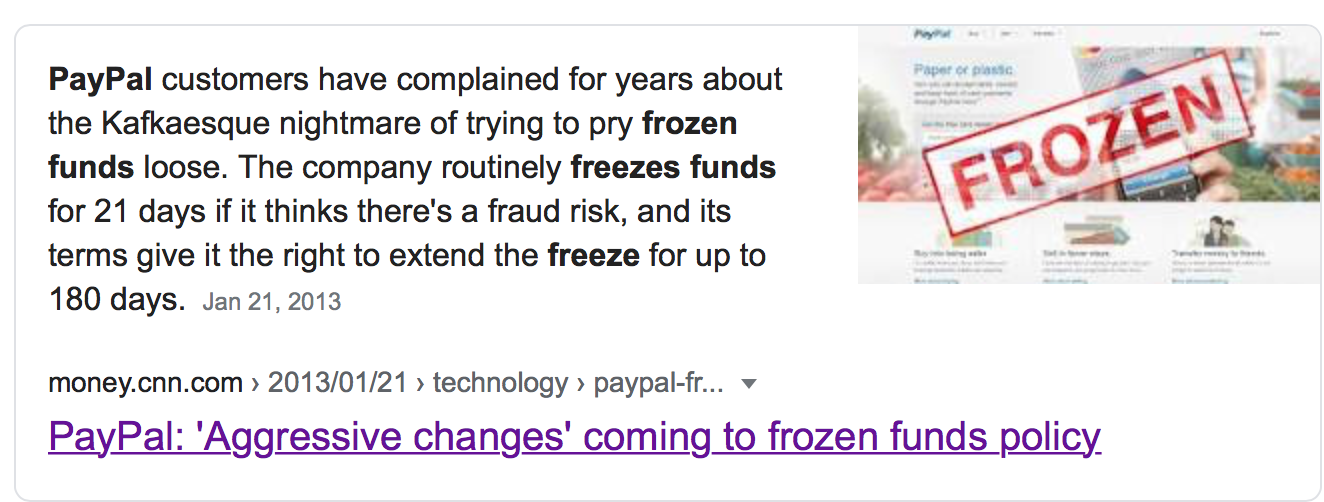
Routines help us cope, and many of us struggle to create them. It’s like a ship lost at sea, in uncharted waters. And yet, land is almost visible on the horizon line. Having to restructure the day, and create new patterns that include physical and emotional self-care may feel the twinge of growing pains but push through it.

You are the architect of new tiny changes that will help create the version of you that is going to pull through this.

As Kendrick Lamar raps:

“That’s why I do the best I can, because I know how blessed I am,”

Stay Safe & Calm Have Hope
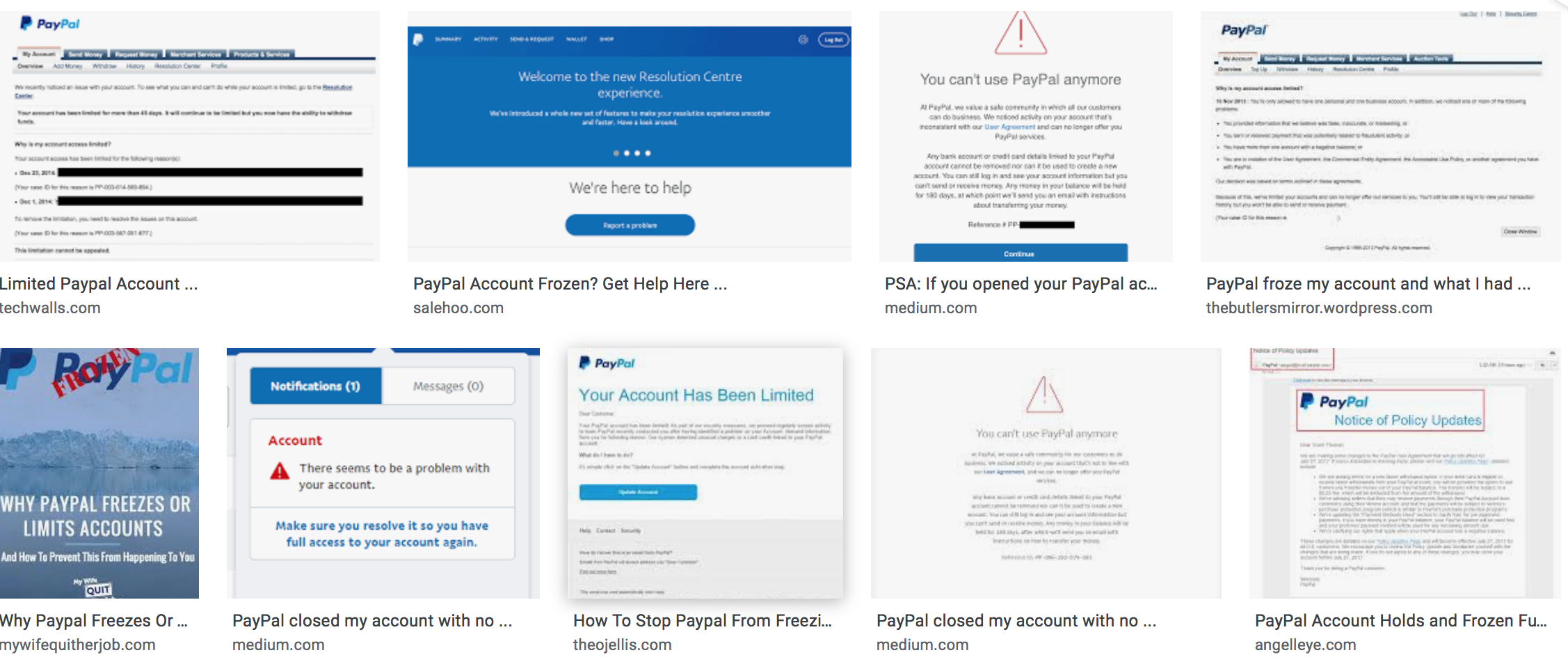
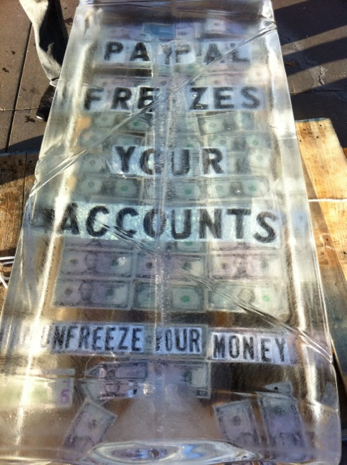
Monday March 23rd 2020 12:14am

In times of uncertainty many turn to faith in god, religion, humanism, the mystic unknown where somewhere something is looking out for mankind against all odds. Our habits and daily rituals become a place we create to seek solace when the world has gone crazy.

When every day feels like we're living in a worst-case scenario movie we cling to our rituals to give us comfort and stability. 
  • Coffee in the morning
  • the daily jog
  • checking social media
  • fixing meals
  • clipping our nails
  • showering and dressing ourselves
  • putting one shoe in front of the other.

Stability is necessary to continue walking, moving, creating something going forward. 

I believe much of the time we are so accustomed to putting our happiness in the future that when the future no longer seems to hold the guarantee of better things we start to lose faith in the process.

It becomes harder to hold our heads as high standing in line, waiting to enter the grocery store, and casting accusatory eyes on anyone who coughs in our proximity. 

"<Ahem...excuse me...wait...what? Where are you running to?>"

As a native Austinite, music is in my blood and one of the telling signs that COVID19 was a serious issue, not just something to take lightly was the canceling of SXSW. Southby, an Austin music festival, perhaps the biggest music festival in the word, while providing many with memories that last a lifetime has a significant impact on local musicians that isn't always positive. 

It's contributed to the gentrification of Austin, Texas as the music festival attracted monied interests with no interest in preserving the culture of the city investors became so enamored with, as historical icons were BULLDOZED for condos & hotels.

As James McMurtry, local legend whose father wrote the book that became a movie, Lonesome Dove, sings: "I'm not from here, I just moved here, from some place far away. People tell me I should've been here before it got ruined by people like me."

A friend of mine recently posted this on Facebook sharing his feelings about SXSW.

And... I agree with these sentiments. I listen to a commercial free radio station called Radio Paradise (most excellent).The owner, Bill, will come on every 15 songs or so and say,

"I hope you are staying safe & calm during these troubling times."

The canceling of SXSW was only the first of many new changes we've had to adapt to in Austin, Texas. It was the canary in the coal mine if you will, as businesses sacrificed and the city, millions of dollars in revenue to preserve public safety and stop the spread of the corona virus.

I apologize, for not keeping up, and blogging more frequently.

I've been fighting an illness that's been quite serious (unrelated to COVID19) and combining that with the panic in the media, the streets, the grocery stores I've been overwhelmed, emotionally and mentally.

For 4 days straight I stared at my computer screen, researching, investigating, compiling documents of data on the outbreak, frozen, in paralysis. Unable to move, literally sitting in bed googling, cross referencing, putting all my research skills honed to perfection working as a professor's assistant back in college to good use. But it was making me sick, emotionally.

I had to step back. I was in too deep.

My health wasn't improving this way, and our immune systems do respond positively to elevated moods. I was re-diagnosed and found I was suffering from an illness that was serious, but not as serious or fatal as the first was I was misdiagnosed as having. Sweat broke across my forehead, I felt a heavy weight lifted off my back, and I broke free of the panic coma I was trapped in.

I started making music again, and realized how perilous the balance is between staying informed and being a trauma-junkie. If it bleeds it reads, was a saying I'd heard as a reporter when I worked at a newspaper in another life. I started walking again, outside, 1 mile, 4 miles, gradually building resilience, internally, to the insanity we're facing everywhere we look.

I cannot emphasize enough, how important it is to maintain your mental health, to develop and practice self-care routines, right now, is crucial. (In addition to washing your hands 20 seconds with soap before splashing water - that's what actually washing your hands is - and disinfecting commonly touched surfaces with bleach spray, lysol, pinesol or white vinegar in a spray bottle and social -correction- physical distancing).

Sorry, I'm ranting again, the OCD level I'm on right now is unparalleled but it's survival. And survival isn't a joke. What are we supposed to do if the ones leading the governments of the world are saying they don't know how to handle this? Questions like this keep many of us awake at night.

We keep forgetting that where there's a will there's a way. We keep forgetting that humanity has overcome epidemics before with less technology and more ignorance. We keep forgetting the power of adaptive radiation. Adaptive radiation is, in the words of Wikipedia:

"In evolutionary biology, adaptive radiation is a process in which organisms diversify rapidly from an ancestral species into a multitude of new forms, particularly when a change in the environment makes new resources available, creates new challenges, or opens new environmental niches."

Yeah uh...We are definitely in the 'creates new challenges' part of that. We are learning how to evolve as a species to preserve our ecological niche in planet earth right now. Scientists, biologists, medics, really smart people all over the world are working to find a cure, aworkaround, a treatment. There is a tipping point where group consciousness will coalesce.

It's the reason why younger people seem smarter at younger ages, in addition to improved living conditions, nutrition and technology there is a certain kind of genetic intelligence that develops faster the more people are born into better environments. To quote Radiohead,

"Fitter, happier, more productive Comfortable (not drinking too much)"

A critical mass is approaching, I'm sure of it, for finding a cure. Whether we repurpose drugs used to treat SARS and MERs (as Dr Fauci mentioned as a possible cure recently) or develop an amazing new treatment in another way - this many minds thinking together, globally, creates its own momentum in a way that evolutionary biology predicts, will pivot our species to evolve to survive.

We will survive this. As my ex told me on the phone today, "This is the planet kicking us in the butt telling us to take better care of our bodies, eat healthier and follow a higher path.

So keep your head up. Have hope. There will be some rocky roads and it ain't all ice cream, but we can and will get through this intact.

Have faith. Be safe. Stay calm.

« Older posts Newer posts »